
Read Full Transcript EXPAND
Hello, everyone, and welcome to Amanpour & Co.
Here's what's coming up.
It would be extraordinary if the court did not face pressure at all times.
A turbulent year for the International Criminal Court, from U.S.
sanctions to the chief prosecutor's ouster over sexual misconduct allegations.
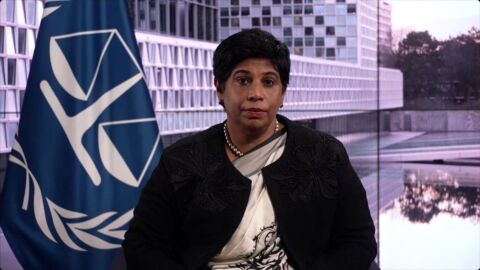
Deputy prosecutor Nazhat Khan is running the show right now.
She tells me how they're navigating this critical moment.
Then... I take great pride in what the Smithsonian has done.
It is not a place that attacks America.
It is a place that celebrates America by helping people understand the complexity of who we are.
The head of the Smithsonian is stepping down amid the Trump administration's a la carte version of history.
We revisit my conversation with Secretary Lonnie Bunch on having to face the country's complex past.
I think that a lot of the extremism that you see on both the left and the right is driven by a revolt against this kind of flat world created by liberals.
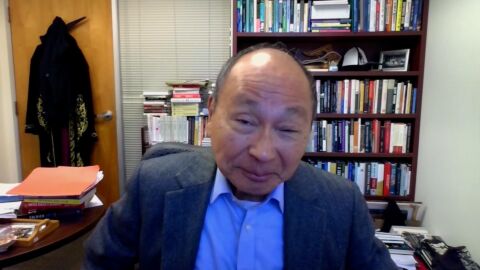
In the realm of the last man, political scientist Francis Fukuyama on his new memoir, and what Trump's presidency means for American liberal democracy.
- Amanpour & Co.
is made possible by committed to bridging cultural differences in our communities.
and by contributions to your PBS station from viewers like you.
Thank you.
- Welcome to the program, everyone.
I'm Christiane Amanpour in London.
A landmark appearance at the International Criminal Court for the first time since being detained in March 2025.
The former Philippine leader Rodrigo Duterte arrived for a hearing at The Hague, where he is due to stand trial later this year, accused of crimes against humanity over his bloody war on drugs.
Tens of thousands were executed under Duterte's leadership.
The work of the High Court goes on despite tremendous pressure from both inside and out.
The chief prosecutor, Karim Khan, was ousted this summer over sexual misconduct allegations, while pressure from the Trump administration has been ramping up, urging allies to quit the court and accusing it of "waging a war against the United States."
The U.S.
has also sanctioned top ICC officials, including the deputy prosecutor, Nazhat Shamim Khan, following the ICC issuing arrest warrants for Israel's Prime Minister Benjamin Netanyahu and former Defense Minister Yoav Golan, as well as top Hamas leaders.
It is a critical moment for the ICC, and Judge Nazhat Khan joined me from The Hague to discuss how the court is navigating it.
Deputy Prosecutor, welcome to the program.
>> Thank you very much.
>> It's been, for all intents and purposes, a very turbulent year around the ICC.
You have had to step in because the former deputy for the former prosecutor has been removed from office because of personal accusations against him.
Meanwhile, the United States has been really publicly going after the court and, you know, threatening its existence, in fact.
We'll get more into that.
But what is the morale, and are you proceeding with the prosecutions of certain world leaders and high-level inditees, defendants who you have?
>> Indeed, we are.
The work of the court continues unabated.
We have trials in court.
We have a trial scheduled for November of this year and one for next year.
We have, in the course of the last year, seen convictions in two major trials, and we continue to conduct our investigations and our prosecutions and appear in court on a regular basis, regardless of these events.
But there is pressure, right?
Do you admit that you're feeling pressure?
I think that it would be extraordinary if the court did not face pressure at all times.
The nature of the work that we do means that we inevitably will face pressure of all sorts to try and toe a political line, for instance, or to take a different position on the charging of accused persons or to follow a path in investigation and prosecution.
So, indeed, we do feel pressure, but, as I've said, the dedication of our staff is extraordinary, and they continue to do their work.
>> I will get into some of those specific cases in a moment, but first I want to say, you know, some of this pressure comes from the most -- I guess the most powerful, important country in the world, that is the United States of America.
And they have said, particularly Secretary of State Marco Rubio, has said several times that they will do everything in their power, use every tool at their disposal to take the court down.
The word is "dismantled brick by brick."
They're also trying to get other countries to pull out of supporting you, of joining the court and the Rome Statute.
Already, Venezuela, Mali, Burkina Faso, Niger, Chad have all said in this past year that they would leave.
So listen to what Rubio has said.
We have lunatics and crazies involved in the ICC that are talking about charging members of the U.S.
military, maybe even the president or a future president, with crimes.
It's not going to happen.
It's just not going to happen.
We are not members of that court.
We never signed on to that treaty.
They need to understand that.
If people want to sign on and be a part of that stupid organization, they can.
But we're not going to be a part of it, and they're not going to apply their jurisdiction to Americans.
That's just not going to happen.
We're not going to tolerate it now or in the future.
And we've warned them about it repeatedly.
And now they're going to see the consequences of ignoring us.
>> Golly, stupid organization run by lunatics and crazies.
How do you actually respond to that?
I know you have to be diplomatic, but how do you continue?
Because they do have the means to make life very difficult.
Basically, you know, they can sanction individuals, as they have you and others.
They can also sanction the whole court.
They can just do everything at their disposal, as I say, to make it irrelevant and impotent.
>> I think that what grounds us is the Rome Statute itself and a very strong memory of how the Rome Statute was negotiated and adopted.
It was adopted as a result of sovereign will, and it was adopted after decades of negotiations.
And I don't believe that those negotiations would have succeeded had the Rome Statute not given space for sovereignty, had not given space for countries to be able to pursue their own investigations and prosecutions and bear the primary responsibility for prosecuting themselves.
>> The question is, are we at a moment that the idea of international rule of law, the idea of accountability for the most heinous crimes, in situations where sovereign states will not do it themselves, are we at a point where that whole concept could be on the verge of falling?
I don't think so.
I think that with a commitment of the existing states of the Rome statute, the way in which we work, the high level of judicial scrutiny, our own processes which focus on the law and the evidence and exclude political considerations, I think that our methodology enables a resilient court, one that is principled in its approach, and one that will act as a buffer against criticisms such as this one.
Deputy prosecutor, let me ask you, you have been for the better part, I think, of a few years now, running the show with a co-deputy prosecutor because of the complaints and then the vote against the then-chief prosecutor, Karim Khan.
You admit, therefore, I assume, that it's not just outside slings and arrows and attempts to disable you, but from the inside, there is something rotten, as well, that needs to be accounted for.
Well, first of all, there is no doubt at all that the investigations and the process in relation to the former prosecutor had an impact on our staff.
And I have said before that this is really now a time of healing for our staff, because it has been a difficult chapter, and Deputy Prosecutor Niang and I have taken responsibility to ensure that our staff is insulated from the negative impacts of those investigations.
But having said that, I also believe that the staff's determination to carry on with the work, to appear in court to do the investigations, and a wish, a willingness, and a determination to ensure that the mandate of the Rome statute continue to be fulfilled, I think it shows that we are resilient and that we are capable of seeing this chapter through, as well.
>> It's a very, very disturbing chapter, and I do need to ask you a few questions about it, because it was finally a victim who made these allegations and accusations against the chief prosecutor, and, in the end, was believed by the majority of your states.
As you know, she came public on this program.
Her name is Sarah.
I want to play for you one of the parts of the interview she gave me about a specific indictment, and that was the one against Israeli leaders and Hamas leaders in relation to October 7th and the war on Gaza.
This is what she told me about the atmospherics around that.
I can't speak to any specific state or individual, but I think many parties have, for their own agenda, conflated the two things.
There can be many reasons for it, because it serves certain interests.
What I do know is that my complaint was because of what happened to me, not for any other reason.
And second, that conflation has only helped to distract and deflect from the validity of that complaint.
The two things need to be separated.
>> I'm sure you agree with that, Deputy Prosecutor, and, of course, what she's saying is, and what she's reacting to, is a campaign of disinformation accusing her of having been a Mossad agent, and it just caused all this real concern about her veracity and about the legitimacy of the case that you, the office of the prosecutor, had brought against, in this case, the Israeli officials.
So, first and foremost, I want to ask you, did you ever believe that Sarah was a Mossad agent?
And if not, why did you never come out and say it?
Why did the court never come out and say that?
>> I think it's really important to remember that there was a process that was led by the Assembly of State Parties.
And that process included an investigation conducted by the United Nations, OIOS.
And so, for the Office of the Prosecutor to make statements about those investigations, to make comments about witnesses or affected or impacted persons who participated in that, I think would have been quite improper.
It would also have, I believe, undermined the neutrality of the Office of the Prosecutor.
So that's the first.
The second is that the comment that is made about conflation, I totally agree with.
As far as the Office of the Prosecutor is concerned, we lay charges, we make applications for arrest warrants on the basis of the law and the evidence.
So any attempt to suggest that we have some other ulterior motive or that staff members have some other agenda is something that we completely reject.
- Deputy Prosecutor Sarah, the woman in question, worked in the office of the prosecutor, and she was one of those, as you described, hardworking lawyers, individuals who worked on that case.
So just quickly, you don't plan to drop the case, right?
That case is still proceeding.
- The case is still proceeding.
We have taken no steps to try and withdraw any of those arrest warrant applications or the arrest warrants themselves, and the team continues to investigate in that situation.
>> Okay, so, therefore, her claim or the claims that she was a Mossad agent were totally false, and now you've explained that you're going to keep doing that case.
The other thing which I failed to say, but I think I assume most people knew, her complaint against the chief prosecutor was one of sexual abuse and sexual harassment over a period of time while she worked for him and in his office.
And she has never been officially declared a victim.
She was the victim of this case, and the result shows that fact.
Why was she never officially called a victim?
-Well, as I've said, that process was led by the Assembly of State Parties.
And how they label witnesses or survivors or victims is, of course, a matter for their processes.
As far as we are concerned, we follow the categories that are set out in our own internal processes, our administrative instructions.
So it's really important that we follow our internal processes, and I have to say in relation to Sarah, that she has every right to pursue her processes, and it's really important also, in the context of this discussion, that we respect her privacy in this matter and respect the fact that she may be pursuing her own processes.
>> Yeah.
I mean, she obviously made a decision to give up some of her privacy in order to be able to talk to us about it.
I want to ask you a bigger question because it wasn't just her, as you know.
There were other women.
They came forward.
There were some men, too, who didn't come forward officially, but who complained about harassment or just bullying.
What can you say to your staff about accountability and changes in procedure that will make sure that this does not happen again?
And if it does, the level of accountability will be much less opaque than it was in this case.
Look, I think that one of the most challenging areas of work for the Office of the Prosecutor going forward is our work on work climate.
Not only do we have to work much harder in ensuring that our processes are respectful, that people recognise when they are being subjected to bullying and harassment, that they know how to use our processes, and they have managers who will understand that and who will support them through the process.
This is still work in progress.
I would be the first to acknowledge that we're not there yet.
We need to work a lot harder on this.
We need to support our staff, and we need to keep reassuring our staff that we're working on this.
But we do need to work on this.
>> It's good to hear you say that, and there'll be many people watching how it goes.
And, of course, we have to say that the former chief prosecutor denies all the allegations against him, despite what the member states decided.
I want to ask you about a specific case now, and that is the Philippine case.
The former president of the Philippines, Rodrigo Duterte, has appeared in court for the first time.
As you know, he doesn't recognize the court's authority.
He claims all sorts of mental and other disabilities he says makes him unfit.
He denies the charges.
What challenge does that present to you?
Because I witness the same behavior from defendants in a lot of the Bosnia cases, whether it was Milosevic, Karadzic, Mladic, who just didn't recognize it and made it very difficult for the court and the prosecution.
>> Well, first of all, the law tells us when the court has jurisdiction.
And we would not even be able to get in through the doors of the courtroom had we not demonstrated that the court had jurisdiction.
Secondly, it is not unusual for accused persons to defy the jurisdiction of the court and say that the court has no right to try them.
We have heard this before, as you quite rightly say, and this is something that we simply take on the chin and carry on with our prosecution.
So I think as far as the court is concerned, the issue of whether or not we have jurisdiction is a legal one.
It's based on the arguments of counsel before the court, and we will continue to be guided by that.
>> Can I end by reverting to the pressure that you're all facing from the United States in this case regarding sanctions?
You personally, I believe, have been sanctioned.
Other human rights defenders and prosecutors in other forums have also.
But in your case, what are the personal consequences of being able to do your work, to live a daily life under U.S.
sanctions?
>> Well, I think that the first, most obvious consequence of being sanctioned is the limited access that you get to financial institutions.
So, you may not be able to stay with a bank, which has provided you with services possibly all your life.
You will certainly have your credit card revoked, because almost all credit cards, I believe, are administered in US currency.
And your transactions, if you live in Europe, with a bank which can continue to offer you services, will be limited to transactions in the SEPA region, so in the Eurozone.
So this necessarily means that your online activity is limited.
And in addition to the financial services, which might be limited, you may also get other types of institutions which do not wish to provide you services anymore, such as health insurance companies.
And lastly, there is an impact on your family because they will not be able to enter the United States as well.
Do you know why you were sanctioned?
I was never given any reasons for the sanctioning, and I don't know.
However, I believe it was because I am a deputy prosecutor at the Office of the Prosecutor.
And do you have hope for the future of international law, the kind of work that the ICC was set up to do?
I do indeed.
I think that the work that we do for victims, the fact that we continue to hear their voices stridently with so much sincerity, they believe in this court.
And I believe that for them, this provides an avenue of justice that may not necessarily be provided in many courts around the world.
And I also believe that every single member of this court works for humanity, and they can mean nothing better than that.
>> Well, on that note, Deputy Prosecutor Nazhat Khan, thank you very much, indeed, for joining us.
>> Thank you.
>> Longtime cultural landmarks in the United States are feeling the heat from the White House this week, especially like the Kennedy Center and the world-renowned Smithsonian Museum, where President Trump plans to place a dozen signs warning the public of the museum's, quote, "liberal and anti-American bias when it comes to American history."
The Smithsonian's secretary, Lonnie Bunch, announced earlier this month that he'll be stepping down at the end of the year precisely over these kinds of clashes.
He was the institution's first African-American secretary and spent the last seven years dedicated to telling the full American story.
So we wanted to revisit a conversation I had on the 250th anniversary of America's independence when I ask Secretary Bunch why telling a full and honest story of American history matters so much.
- I think it's really important that we have a commitment to telling the complete story of America, to tell a story that really is a story of many peoples who have shaped this nation, some that people want to not talk about, but I think our job is to say, how do we tell an accurate history driven by scholarship that's nonpartisan, that challenges America to live up to its ideals, that celebrates America, but also celebrates that the great strength of America is that people have voted, debated, pushed to help America live up to those ideals.
So it's our job to tell an accurate, complex, and truthful history.
>> So before I get to some -- to ask you to react to some of what's coming at you from the administration, I want you to talk about, in this vein, when you say we have to celebrate everything, everybody, and all the U.S.
achievements, you tell a story in your memoir about, you know, as a young historian, you met Prince E. Jenkins.
At the time, he was a man in his 90s, grandson of enslaved people at a plantation in South Carolina.
And he told you, as a historian, your job better be to help people remember not just what they want to remember, but what they need to remember.
How did those words first, you know, hit you?
And how do you think about them now at this time?
You know, when he said that, I realized that those words were going to shape the rest of my career, that it really was important to understand what people knew so that you can sort of celebrate those stories, but to also say, but it's also important to understand stories that you may not want to know because they're all part of shaping who we are.
And so, for me, Princey Jenkins' words are really my North Star.
Every day, I think about the fact that he challenged me to make sure I help people become better by understanding the complexity of the past.
So you've made it very clear that you plan to keep those words, you know, at the center of your celebrations, to understand the complexity of the past, not to allow any forces of politics to diminish what you want to show via the Smithsonian.
And there you have co-curated basically the centerpiece of the exhibit for the 250th called "American Aspirations."
What did you set out to do there?
Apparently, you chronicle through more than 30 objects taken from the Smithsonian collection.
>> What I wanted to do was to say that America is as much an ideal as it is a place, and that many of those ideals really can be traced to Jefferson's words in "Declaration of Independence," that for me, the Declaration of Independence challenges us to be a nation in pursuit, in pursuit of fairness, in pursuit of opportunity, in pursuit of sort of new horizons.
So what I wanted to do was to take Jefferson's ideas, to say it's important to celebrate and understand those words because really for 250 years people have done everything they can to make those words concrete, to make those words accessible, to make those words meaningful to everybody in America.
So I wanted to look at that by saying here are certain aspirations, aspirations of fairness, of hope, and how do we use one or two objects?
Because as you know at the Smithsonian, if you come to an exhibition there are hundreds of objects.
I wanted you to have a very intimate experience.
I wanted you to start by looking at the desk that Jefferson wrote Declaration of Independence on and to use those moments to get you not just to look at the past, but to think about what that means to us today.
And so the challenge is really saying, take a few objects, let people have an intimate experience with those objects, and basically use those to have people grapple with what it means to be an American, what it means to understand our history, what it means to understand the fullness of our history.
- And we're looking at some of those images right now.
And of course Jefferson may be slightly complicated.
I'm going to ask you what you think about it, because while he wrote the basic creed of American democracy that all men are created equal, I'd like to think he might have added all people in today's world, that he was also a slave owner.
He had enslaved more than 600 people over the course of his life.
How do you reconcile that contradiction?
How should people all these years later reconcile that?
- I mean, I would suggest that one of the ways to understand Jefferson is to understand who he was in the fullness, that he was a slave owner, that he understood what the lack of freedom meant because he saw it every day.
And yet, I think the challenge is to recognize that through the words, even though his words were not for everyone, we've taken those words and said they're part of who we are as Americans.
And so what you see is whether it's women, abolitionists, immigrants, using those words to say, we just want America to live up to those ideals that are outlined by Jefferson.
So, for me, Jefferson is a complicated person.
Race is really crucially important to understanding who we are as a people.
But it's also important to say those ideals that he penned are ideals that people have now seized and tried to make them accessible and meaningful for everybody.
That's the challenge and that's the contradiction.
>> And, again, it's especially the challenge now as there seems to be a deliberate attempt to roll back and to sort of almost sideline that history.
And we're also in a moment -- I mean by the administration, not by people, but by the administration -- we're also in a moment where one of the other key principles of America, i.e., the welcoming of, you know, "Bring me your tired, your huddled masses," is that we have a model of the Statue of Liberty.
It's the one that was -- we know it was designed by the French designer Frédéric-Auguste Bertoldi, presented to the United States in 1884.
And let's not forget that it stands -- she stands on broken chains.
Tell me what that means.
What should people know about that today in the context of the and the idea of the Statue of the Idea of Migration and Refugee and Asylum.
I mean, in many ways, the role of the Smithsonian is to give you different lenses into a subject, to give you more complexity.
And so on the one hand, when you take that maquette that really was a gift from France to the United States, we now see it as a symbol of immigration, right?
The Emerald Azarith poem, and it's something that has greeted so many immigrants coming into New York Harbor, and that's unbelievably important and very, very powerful.
But it's also the fact that she is standing on broken chains and that it was really given to us by France to celebrate the fact that the United States abolished slavery.
So in many ways, what I want people to understand is that, yes, it's a story of immigration and it raises fundamental questions about how we are a nation of immigrants and what does that mean.
But it also helps us understand that slavery was so central that even the French said, "We celebrate America," because they took that amazing step to abolish slavery in 1865.
So, let me now bring up some of the invectives, if I could, I don't know, use that term, from the president himself.
Quote, "The Smithsonian is out of control," in caps, where everything discussed is how horrible our country is, how bad slavery was.
Respond.
Well, I think that, first of all, if you go through the Smithsonian, as I do almost every day, and you look at the stories we tell, it is a complex story, but it's a story that celebrates America in many ways, but also argues that there's nothing wrong with helping a nation realize that it's a work in progress, that people have struggled to end slavery, struggled to make sure there was fairness in terms of issues of gender.
So, for me, it really is not saying we're trying to criticize America or say, "What a horrible place."
We're just simply saying you celebrate America because in some ways America has grappled with some of the greatest challenges it's faced.
And that for me what's important is I believe that Americans are this amazingly brave people who you know defeated Nazism and the like and it scares me when people aren't brave enough to face their history.
And in some ways you have to face it anyway.
You know, there's no way of running away from the impact of immigration or the impact of labor issues.
So for me, it's really an opportunity to basically say, let us understand America.
We celebrate, we commemorate, but the goal is to understand.
And you can only understand it when you grapple with the complexity of who we once were.
It shapes who we are today and hopefully can point us towards a better future.
>> And it's hard.
It's a challenge for you.
I mean, you have been in the crosshairs.
The Smithsonian has been in the crosshairs of this administration.
There was an executive order by President Trump accusing the Smithsonian of promoting "narratives that portray American and Western values as inherently harmful and oppressive."
And it's called for an end to your spending on programs and exhibitions that, quote, "degrade shared American values, divide Americans by race, or promote ideologies inconsistent with federal law."
Is that what you do, Secretary Lonnie Bunch?
You know what we do?
We try to tell a complicated story that is driven by the best nonpartisan scholarship we have, and that, candidly, I learn when everybody offers criticism, I listen.
I say, are we doing the best we can?
How do we convey the stories in a way that the public will understand?
But the reality is, the North Star for us is the notion of how our scholarship helps America understand the complexity, the nuance, the subtlety.
It's a hard thing to do.
Many people want simple answers to complex questions.
Our job is to sometimes do that, but more importantly, give you questions and answers that will make you understand the complexity of who we are as a nation.
And I take great pride in what the Smithsonian has done.
It is not a place that attacks America.
It is a place that celebrates America by helping people understand the complexity of who we are.
You know, I was struck by some of the research I read and you spoke about a meeting with President Trump, and I believe you showed him around the Smithsonian, and you had a different experience with him than some of these posts would suggest on Truth Social or some of the executive order writings or some of the things that some of his lieutenants, for instance, write, like Russell Vogt, who, you know, is basically saying, "We wish to be assured that none of the leadership of the Smithsonian Museums is confused about the fact that the United States has been among the greatest forces for good in the history of the world.
Tell me how your actual meeting with Trump at the Smithsonian went.
Well, you know, that was a tour I gave him of the National Museum of African American History and Culture, where I was the founding director.
And clandidly, it was a tour where we grappled with the challenges, and he came out saying it was a good experience.
And so in many ways, I felt that part of the job of the Smithsonian is to give everybody an opportunity to educate, to be educated, to learn something new.
And I think he learned something new as he walked through the museum.
I think that it's important that I am not trying to say the Smithsonian versus the administration.
All I'm trying to do is to say that we want to help America, and we're doing the best we can by being nonpartisan and really being driven by the best scholarship.
And how is it going, the exhibit?
Are you getting floods and floods of crowds and things?
And I also want to ask you how this careful line that you have to tread as the leader of this great cultural institution at this time, how has it been affecting you?
Well, I mean, first of all, the Smithsonian has some of the best attendance it's ever had in recent years.
There's a lot of people going to see the exhibitions because they want to sort of understand America through different lenses.
You know, for me, you know, I am lucky because I get to work with 7,000 gifted public servants every day whose job it is, whether they are scholars or educators or designers, their job is simply to say, "We want to help a nation better understand itself."
And they do it with amazing dedication.
So whenever I feel, "Oh, my goodness, I'm being attacked," I dip into that reservoir that is the Smithsonian, that is the staff, that is the history of the Smithsonian, that for 180 years, the Smithsonian has grappled with science, art, history, culture, in a way to help Americans dip into that and better understand themselves.
That keeps me going no matter what.
>> And you're so devoted, obviously, and so passionate.
The New York Times has written that this, you know, the American Aspirations exhibit, which you curated, will probably be the last exhibit you will create, quoting you.
>> Well, you know, there's a difference between saying I may not curate another exhibition versus how long I'm going to stay as secretary.
I think that's a distinction.
I mean, I think I don't have much time to cut the curate anymore.
That's what I was trying to get at.
Yeah, I know.
You know, the reality is that I've been secretary for seven years.
This is my 37th year at the Smithsonian.
It's a place I love better than anything else other than my family and the New York Yankees.
Other than that, the Smithsonian is what I care about.
And so I'm committed to doing everything I can to help the Smithsonian continue to build on the amazing traditions of 180 years.
At some point, I will step down.
But the reality is that as long as I can sort of have the support of the staff, of the Board of Regents, and really do the work that the American public enjoys and is engaged by, I'm very lucky to be the Secretary of the Smithsonian.
>> And we are lucky to have you on our program.
Thank you so much for helping us all celebrate the important diversity of America at 250 years old.
Lonnie Bunch, thank you so much.
>> My great pleasure.
Thank you.
>> As we've heard, President Trump has been pushing his executive power to the limits, showing little respect for the guardrails of U.S.
liberal democracy.
Our next guest made his name 37 years ago with his landmark essay, "The End of History," celebrating the triumphs of liberal democracy over Soviet communism.
Now, political scientist Francis Fukuyama has a new memoir, "In the Realm of the Last Man," and he's joining Walter Isaacson to reflect on what he got right and wrong nearly four decades ago and the powers that still threaten this political system.
Thank you, Christiane and Dr.
Francis Fukuyama.
Welcome back to the show.
Thanks very much for having me.
In your new book, "In the Realm of the Last Man," you say you wanted to set straight some misconceptions about your 1992 work, "The End of History" and "The Last Man."
What were those misconceptions?
Well, there are several.
I mean, some people just read the title and assumed that I meant that events would stop happening, which was obviously not the case.
A slightly better interpretation was that I was being a naive triumphalist about democracy spreading everywhere.
The reason I picked the title in the realm of The Last Man was that the title of the original book was The End of History and The Last Man.
Most people didn't read the last five chapters on The Last Man, which was about how democracy could break down in the future because of some of the intrinsic stresses within a liberal order.
So that was really, you know, what that was about.
Well, you were right in many ways.
Your book came out right after the end of the Cold War, and I think the number of democracies went from about 30 to 100 right after that.
There was a burst of democracy.
Let's start there.
Why did that happen?
Well, there's a lot of causes.
I think part of it had to do with the problems within autocracies.
You know, China had just gotten over the Cultural Revolution.
It was liberalizing very rapidly.
The old system there didn't seem to be working.
And then Gorbachev unleashed perestroika and glasnost in the former Soviet Union.
And both of these two powers were the leading alternative systems, communist systems, and both of them seemed to be in big trouble.
Also, the United States was doing well itself.
You know, you were at the end of the Reagan era when the United States had regained the confidence that it had lost in the 1970s, and its influence and its model seemed to be spreading everywhere.
So let's talk about "In the Realm of the Last Man," which is the last five chapters of your 1992 book, the theme of this.
"The Last Man" is sort of a concept from Nietzsche.
What do you mean by that?
Well, Nietzsche really hated English liberalism.
He felt that it flattened people's horizons, and because it asserted that every human being was equal to every other human being, there was no room for greatness, for striving, for struggle, for risk.
And he really thought that this world would produce kind of the opposite, that people wouldn't be satisfied with such a flat, you know, world with such a low horizon.
And therefore, you would have a revolt against the last man, and that would be a revolt against democracy, because, you know, you have a lot of people in the world that want to dominate, that want to prove that they're better than other people.
And that was the power that he saw unleashed.
And is that what we've seen happening for the past 10 or 20 years?
So I think that a lot of the extremism that you see on both the left and the right is driven by a revolt against this kind of flat world created by liberalism.
In a liberal society, you have to tolerate everyone.
There's a plurality of views about the good life, and people want more.
They want a sense of community, but more than anything else, they want a sense of struggle.
And you saw that, for example, in all these guys on January 6th that dressed up in camo and stormed the Capitol.
They pretended that they were brave patriots trying to defend the American way of life.
And you know, it was play acting, basically.
But I think it bespoke a kind of desire to struggle for the sake of struggle.
And it's very dangerous, I think, to our democracy.
So this is a populist movement towards more authoritarian.
You say it's a bit of a backlash against liberal democracy.
By liberal, you mean sort of a tolerant, individual rights-based democracy.
And why would that be a problem?
Well, I think my definition of a liberal state is one that operates by a rule of law that restricts executive power through law, through a system of constitutional checks and balances.
And there's two things that people don't like about that.
I mean, first of all, this idea of the premise of liberal society is that everybody deserves equal recognition is something that makes people unhappy because they want, you know, a greater sense of community.
They want to emphasize the nation, its traditions and values, but that necessarily doesn't include everybody in the actual society.
The other big problem, I think, is that liberal societies are based on a rule of law, but they tend to accumulate too much law.
They tend to have lots of rules and procedures that you have to follow when you arrest somebody, when you build a train line.
And I think that part of the appeal of a strongman is that the strongman isn't limited by rules.
The strongman just uses force of will to get things done.
And I think that's part of the appeal of people like Donald Trump and Elon Musk.
Do you think Donald Trump is a product of this revolt against liberal democracy?
Oh, absolutely.
I think that he has a concept of power that is really incompatible with the kind of liberal constitutional regime that our founding fathers set up.
He wants his personality and his priorities to be the ones that, you know, define the nation that he's leading.
So I think in that sense, he's a very, you know, big danger to our liberal order.
Well, this has been happening all over Europe, in the United States, this nationalistic, populist, strongman, somewhat authoritarian yearning.
What did liberalism do wrong?
Well, I think one of the things, especially in Europe, well, but also in this country, too, that defines the nationalist right is immigration.
People believe that they are losing their culture.
They believe that they've got a certain set of values, in fact, a kind of common ethnicity that defined who they were.
And you're having these floods of people from, especially from developing countries entering and bringing their own customs.
And in a liberal society, you have to tolerate different ways of life.
So that, I think, is one of the big themes that really got Donald Trump elected and is helping, you know, like the AFD, this nationalist party in Germany.
Well, you come from a family of immigrants.
Indeed, some in your family, your uncle and your aunts, were interned during World War II because they were Japanese immigrants.
We now see in Texas some politicians demonizing Asian immigrants for being successful enough to get into the University of Texas.
How does your own background inform your thinking about this backlash against immigration?
Yeah, by the way, some of those relatives of mine who were interned were actually born in the United States and were American citizens, and that did not prevent the government from basically holding them for three years during the war.
I think that it makes me very sympathetic to the people that are fighting back against the ICE and the current way that this administration is treating people.
It's outside the bounds of law.
I'm particularly unhappy with Donald Trump's effort to overturn the 14th Amendment's birthright citizenship.
I would not be a citizen if he overturned that, because my mother was a Japanese immigrant on a student visa at the time at the University of Chicago when I was born, and therefore I would have been denied citizenship under the rules that they favor.
And so I think this really affects me, you know, very personally.
You frequently reference the Greek concept of thymus.
Am I pronouncing it right?
Thumos.
Yeah, thumos.
The individual's desire for recognition and for dignity.
How is that something that, I'll say, we, meaning those in the West who felt triumphant at the end of the Cold War, how did we, is that something we missed?
I think that it's something that economists miss because they focus on the material satisfaction of desires, but there's something that actually is oftentimes more powerful in politics than that, which is this desire for recognition.
You know, a lot of the people in the MAGA base supporting Donald Trump feel that the liberal elites, the educated liberal elites that live in big cities, really don't respect them.
They think they're a bunch of yahoos that, you know, don't know what they're voting for.
And I think that unfortunately, there's, you know, a degree of truth.
One of the things that's happened in American society and also in other advanced societies is that people have resorted themselves sociologically.
So it used to be that the left-wing parties were based on the working class.
That's true of the British Labour Party and of the Democrats in this country.
But both of those parties in recent years have become parties of educated professionals, and they've kind of lost touch with the working class.
And that divide is not just an economic divide, it's a cultural divide in terms of what kind of music you listen to, what kind of sports you enjoy.
I think most college-educated people don't go to UFC fights.
You know, they just don't.
And so I think that that reinforces the sense on the part of people without those elite educations that, you know, they're being looked down upon, and that really generates a lot of anger and support for populist politicians.
One of the things I found very admirable in your book is talking about how you've changed your mind.
That seems to be a talent we've lost, we've kind of lost in our society today.
And I noticed that in things you change your mind on, I felt I'd gotten wrong too and have changed my mind.
But let's talk about those.
You chart how you change your thinking on the 2003 invasion of Iraq, your faith in free markets and free trade, and your move away from conservative politics.
Tell me how those were connected.
Well, first of all, I think that the Iraq War especially made me question this kind of classic model of human rationality.
You know, since the Enlightenment, people think, well, human beings take in empirical information, they process it, they look for patterns, and then they build conclusions based on that.
I think that the real way that people think is what's called motivated reasoning, which is that they start out with the conclusions that they want to affirm, and they use their cognitive power to marshal evidence to support those conclusions.
I mean, you see that, you know, just in the way that people have flipped in politics.
You know, Republicans that supported free trade under Ronald Reagan all of a sudden are told that, you know, tariffs are good, and so they start looking for reasons to support tariffs.
That was certainly the case with the Iraq War.
Part of the reason that I supported, you know, in the early stages, the invasion of Iraq, was that my friends did that.
I was in the circle of neoconservatives, and if you go against that consensus in that circle, you're basically ejected from it.
And that, I think, is a step that many people are very reluctant to take.
What do you think we could do to get out of this period of polarization?
Well, that's a big question.
I think that it's not necessarily going to be solved by, you know, greater equality, although I do think that reigning in some of the oligarchs and some of the big concentrations of wealth, you know, might help a little bit.
A lot of it is cultural.
I think that it really has to do with this feeling that many working class people have that they are not being listened to.
And I think that listening better and also, you know, talking in a different way is something that politicians that want to reach out and begin to heal some of those divisions have to take seriously.
The other thing is that it turns out that even a polarized society can actually get together when they've got concrete tasks.
And one of the things that we've not been very good at doing is, you know, building things again.
You know, like infrastructure.
We were promised high-speed rail in California back in the 1990s, and it really doesn't exist today.
And I think that if we had a government that could actually accomplish things that people saw as concrete proof that government was effective, they would get together more.
I mean, you see this actually in cities where there's less polarization than in the nation's capital, because, you know, cities have to take out the garbage, they have to keep the streets paved, and it's much easier to focus people's attention on real-world tasks that government is supposed to do in the first place.
And so that might be a way of, you know, getting out of this morass that we find ourselves in.
What type of message and what type of leader could best follow a Donald Trump?
Well, I think that the nature of executive power is probably going to change.
You know, Trump has tried to basically turn the presidency into a kind of dictatorship where he can do everything by executive order.
I think, however, that we do need a little bit more ability of the government to actually do things, not by, you know, breaking the law and doing manifestly unconstitutional things like Trump has done, but by strengthening, you know, the ability of the president, governors, other leaders to actually, you know, accomplish things.
That can be done by modifying some of the myriad constraints that we put on, you know, on political action.
And I think it's going to be particularly an issue if, you know, someone from the progressive wing of the Democratic Party becomes president.
There, I would say, there's actually a kind of danger, because there's going to be a lot of opposition.
It's going to be very hard to get a real left-wing agenda through Congress.
And then there'll actually be a kind of temptation to imitate Trump, to simply disobey or ignore the kinds of constraints and rules that exist, rather than trying to modify those rules to make action a little bit more—a little bit easier.
Well, one of the great themes of your 1989 article, your 1992 book, was that at the end of the Cold War, there was a sense of optimism.
Do you think one of the underlying problems is that we've lost our optimism?
And how can we regain that?
Well, I think there's a cultural side to this where we don't really have the kind of fear of extremism that really generates support for liberal values and a liberal system.
And I think that, you know, perhaps, unfortunately, experiencing a little bit more turmoil where we're kind of in a conflict together might do that.
I don't think that's a good alternative because, you know, that's the path to, you know, outright conflict and violence.
I think that, you know, if you think about leaders in the past during the progressive era with Teddy Roosevelt or in the New Deal under Franklin Roosevelt, the country did really big things.
It built Hoover Dam.
It electrified the Upper South, you know, and the TVA.
It engaged in—well, the most amazing one was actually going to the moon.
Kennedy announced the intention to land an American on the moon in 1961, and eight years later it was actually accomplished.
And so I think that if you had leaders that could think big in terms of national objectives and then knew how to restructure the government in ways that actually brought that about, that might be inspiring enough to give people the optimistic sense that, yeah, actually, as a collective entity, the United States can actually do stuff again.
Dr.
Francis Fukuyama, thank you so much for joining us.
Thank you very much for having me.
>> Always vital to keep challenging the status quo.
That's it for our program tonight.
If you want to find out what's coming up on the program every night, sign up for our newsletter at pbs.org/amanpour.
Thank you for watching, and goodbye from London.