
S40E2
Sun Ra: Do The Impossible
Discover the extraordinary life of poet, philosopher and music visionary Sun Ra. With his ever-evolving collective, the Sun Ra Arkestra, he self-produced more than 200 albums, stretching the boundaries of jazz.
Features
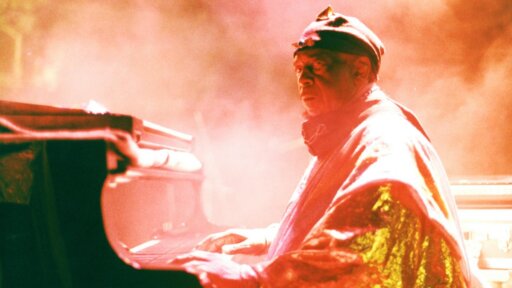
How Sun Ra created his own record label, Saturn Records
Sun Ra was one of the first Black artists to have his own record label.
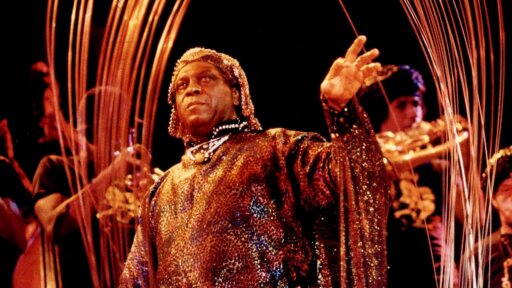
Sun Ra’s concept of “alter destiny” was his way of changing humanity
Sun Ra wanted to change humanity with his concept of the “alter destiny.”

How Sun Ra gave thanks to the Creator
Each day, Sun Ra wrote a piece of music solely for “the Creator.”
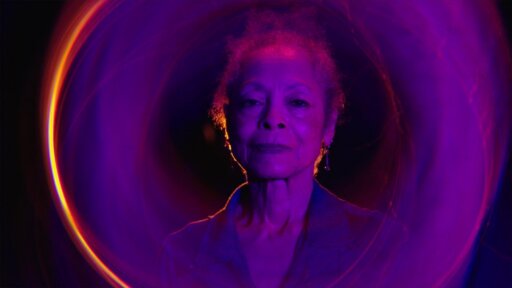
Sun Ra's profound impact on Arkestra members
Sun Ra had a profound and lasting influence on members of the Sun Ra Arkestra.
TRANSCRIPT
♪♪ ♪♪ ♪♪ ♪♪ ♪♪ ♪♪ -♪ Imagination is a magic carpet ♪ ♪ Upon which we may soar ♪ ♪ To distant lands and climes ♪ ♪ And even go beyond the moon ♪ ♪ To any planet in the sky ♪ ♪ If we came from nowhere here ♪ ♪ Why can't we go somewhere there?
♪ ♪♪ ♪♪ ♪♪ ♪♪ ♪♪ ♪♪ ♪♪ ♪♪ -I believe that it is genuinely a mischaracterization to speak of one Sun Ra, right?
At any given time there was a whole bunch more.
♪♪ Sun Ra the virtuoso, teacher, bandleader, the poet, the cosmologist, the historian, the Egyptologist, community leader, the patriarch, the mother, and that's just scratching the surface.
♪♪ -He was pretty fearless, and it would take a lot as a Black man to do all of the things he did with so much sovereignty, with no examples of anyone like him in existence at all.
-I think of Sun Ra as one of the great visionaries of the 20th century.
He's someone who made his life into a work of art.
Every moment of his life feels like a performance and a provocation and a prophetic statement.
You think you know where things stand, you think you know what the issues are, and then someone comes in who changes the frame of reference entirely.
-Sun Ra is a pioneer in Afrofuturism.
He influenced mainstream cats.
He influenced underground cats, everybody.
His influence is just that vast and he was making music for the future.
-Sun Ra thought that if he could reorder our way of thinking through sound, he could prepare us for a different world.
That was his goal.
A different world.
♪♪ ♪♪ -Someone who is certain to be written up in the Black music history books.
He is Sun Ra and he joins us today with his big band group, the Arkestra.
I understand in reports that you believe you're an angel and that you were born on Saturn.
Is that, uh -- Set us straight.
Is that an act or do you really believe that?
-Well, I wasn't born there.
I came from there.
I don't remember being born.
I've dealt with eternal things.
Eternal things are not born.
-You came from Saturn?
-Yes.
-You are not a human being?
-No.
-What are you?
-I'm an angel.
I probably have been promoted to be an ark angel now.
Not too much that a man or woman can do about this planet.
It takes an angel.
♪♪ -In 1936, Sun Ra claimed he was in a white light lifted to another place that he recognized as Saturn.
♪♪ -My body was transmolecularized, that's what I call it.
It became like light beams.
I could see through myself and I went on up.
♪♪ -Aliens told him that through music he would be able to deliver this complex but beautiful message of peace to the world.
And so he comes back down with this powerful sense of mission.
♪♪ ♪♪ -There's no stage persona called Sun Ra.
That was him all the time.
24/7.
And for the longest time Sun Ra did a really good job of keeping his earthly origins a state secret or something.
That wasn't consistent with who he wanted you to think he was and where he wanted you to think he was from.
♪♪ ♪♪ Birmingham, Alabama, also known as the Magic City, is where Sun Ra was born, in 1914, and his name was Herman Poole Blount.
-Sun Ra was mentored by a man named Fess Whatley.
Fess Watley was a great musician who lived in Birmingham and he helped develop a lot of the musicians that came out of Birmingham in that time.
-Sun Ra rose to the top as a teenager.
He was known as having the best band in a city as important in the Black South as Birmingham.
♪♪ -The bands were more than just performances, they were our communities.
They were everything if you were a musician.
Those 18, 20 people that you traveled with a lot, you were like a family.
-Big band leaders consider themselves royalty.
They call themselves counts, kings -- King Pleasure, Duke Ellington.
-He would talk about how when he was young, Duke Ellington would come to Birmingham, like, he would take his music to Duke Ellington.
He would say "Look at this," Duke would look at his music and say "Stay on it, keep on it."
♪♪ ♪♪ ♪♪ ♪♪ ♪♪ ♪♪ ♪♪ ♪♪ -He was an encyclopedia for movements in jazz.
He felt that every phase of jazz from New Orleans to the present day should be respected.
-Sun Ra's whole breadth of sonic expression comes out of our entire past.
He's a master at it.
[ Cheers and applause ] -Now the draft becomes the means of mobilizing the mightiest fighting force in United States history.
♪♪ -Sun Ra was 27 years old when the United States entered World War II in 1941.
-Sun Ra had become anti-war by reading DuBois and Gandhi.
The idea of going and killing somebody was just beyond him.
So he declared himself as a conscientious objector.
-This was by no means common, or well received for the masses of Black people.
We were fighting to prove ourselves as soldiers within their army, and Sun Ra wasn't having that.
♪♪ ♪♪ -They arrested Sonny and they put him in jail.
His incarceration separated him from his one love in life, music.
He wrote letters from his confinement to authorities that he hoped could help him by relieving him of it.
-The arranging and composing, the rehearsing, the developing of potential talent, that is my work and the only earthly pleasure I love.
To separate me from music would be more cruel than standing me by a wall and shooting me.
I think I would prefer the latter.
-Sun Ra was jailed in Birmingham for being a draft resister, and eventually he was transferred to a camp in Pennsylvania.
-His family disowns him.
They never come to visit him.
He's gone.
He was sent back to Birmingham, but now Birmingham was abhorrent to him.
-When he returned, people acted like they had forgotten him and like they didn't want to have anything to do with him.
He hung out in Birmingham for a while, but he really felt a really profound sense of alienation.
♪♪ ♪♪ -♪ Dream, dreaming, dreaming, dreaming, dreaming ♪ -♪ Here I am dreaming again ♪ -♪ Here I am dreaming again ♪ -♪ Dreaming, dreaming, dreaming, dreaming ♪ -In the mid-'40s, Sun Ra migrates to Chicago like many African-Americans, sort of the tail end of that Great Migration.
He arrives in a space that is possibly one of the most richest musical cultures at that particular moment.
-♪ Dreaming, dreaming, dreaming, dreaming ♪ -He seeks out Fletcher Henderson, someone that Sun Ra just idolized as an organizer of sound and of people.
Sun Ra gets a foot in the door and is basically a rehearsal pianist and then also a copyist and arranger.
Fletcher seems to understand the promise of Sun Ra, but he's not exactly a seamless fit with the orchestra.
He was wired a little differently.
And so the musical ideas that he was setting to paper, the way that he was expressing them at the piano, there were members of the band that resisted his influence and in fact resisted him.
♪♪ -In Chicago, in the early years, Sun Ra is part of a scene that is not simply about musical performance but is about political activism.
There's a place in the Southside of Chicago called Washington Park.
What you see is people giving harangues, getting up on a soapbox and trying to attract an audience.
Sun Ra had a soapbox, too.
He brought these broadsheets.
There are dozens of them.
And they're making these really interesting connections among realms -- music, popular culture, politics, history, myth, and cosmology.
-He represents a tradition of Black seekers who are autodidacts.
And they teach themselves.
They read their own books.
Alternate bibles, different spiritual traditions, different magical traditions, and they take them all quite seriously as a way of creating narratives of Black identity, Black culture, and Black possibility.
-If you're not a myth, whose reality are you?
If you're not a myth, whose reality are you?
If you're not a reality, whose myth are you?
Whose reality are you?
-He believed that Black people are sort of stripped of our mythology and he felt he was put here to bring back a mythology, create a realm in the Black imagination.
He thought we don't have enough of a fantasy world, and our fantasy world is often vulgarized and pushed toward very carnal things -- sex, violence -- and myth allows this sort of breathless backing away from all the carnal world and to fantasize about what would it be like to be a god?
Can he be a god and a king?
What would it be like to wear a crown?
He was able to really pick up on the fact that there wasn't anyone who was doing the actual grunt work of creating a Black mythological world.
In Chicago, Herman Poole Blount decides to transform and change his name to Le Sony'r Ra, but publicly for his professional identity, Sun Ra.
♪♪ And in that, we see him beginning to coalesce the intellectual, the political, and the artistic into an identity that will become even more powerful later on.
-My music concerns the cosmos and the greater universe.
It also concerns the myth of things, in opposition to the reality of things.
So it moves out beyond just music.
-He begins to put together small groups of like-minded musicians who he could teach, who he could share his visions with.
People like John Gilmore, Pat Patrick, Marshall Allen, musicians who would remain with him as long as he remained on the Earth.
♪♪ -He was the first one to really introduce me into higher forms of music.
Past what you might say Bird and Monk and the fellows were doing.
I didn't really think anyone was ahead of them until I met Sun Ra, you know?
Very highly advanced, you know.
So when I saw that I said, "Well, I think I'll make this the stop," you know?
♪♪ -When Marshall got in the band, he had to come to the house every day by himself for rehearsal.
-Drill you, drill you, drill you, drill you, drill you.
You couldn't get away with nothing, with all your slick stuff.
And he didn't want that.
He wanted this.
-When he gets together, six, eight of these people, he realized he has an ensemble on his hands, and he calls that ensemble The Arkestra.
♪♪ ♪♪ ♪♪ ♪♪ ♪♪ ♪♪ ♪♪ ♪♪ -The newest sounds to come along in contemporary jazz are written by the composer, arranger, Le Sun Ra out of Chicago.
Le Sun Ra, among other things, fuses the snakelike bebop melodies with colors of Duke Ellington, and the experimental changes of Thelonious Monk.
Le Sun Ra says of his music, that it is a portrayal of everything the Negro really was, is, and is going to be, with emphasis focused on the Negro's triumph over the demonic currents of his experience.
♪♪ ♪♪ -♪ I have many names ♪ -♪ Many names ♪ -♪ Names of splendor ♪ -♪ Names of splendor ♪ -♪ Names of shame ♪ -♪ Names of shame ♪ -♪ Some call me Mr.
Ra ♪ -♪ Some call me Mr.
Ra ♪ -♪ Others call me Mystery ♪ -♪ Others call me Mystery ♪ -♪ You can call me Mr.
Mystery ♪ -♪ You can call me Mr.
Mystery ♪ -As Sun Ra told us, he has many names.
Sun Ra.
Sun Ra and his Arkestra.
Sun Ra and his Myth-Science Arkestra.
Sun Ra and his Solar-Myth Arkestra.
Sun Ra and his Astro Intergalactic Research Arkestra.
Sun Ra and his Year 2000 Myth Science... -Sun Ra is one of the first Black artists to own his own record label, Saturn Records, with his partner Alton Abraham.
♪♪ -How do you decide what's going to come out on Saturn Records?
-Whatever I think people are not gon' to listen to.
I always recorded it where it would take them some time maybe 20 years, 30 years, 40 years before they'd really hear it.
-You had different jazz musicians that were releasing music independently.
Max Roach and Charles Mingus had a label together, but I think Sun Ra might've been the most robust example because he did it for so long.
It's everything from swing to bebop to progressive, to music that doesn't even really sound like music.
That's a lot of music to go through.
A lot of Sun Ra fans that I know personally, I don't even think they've gotten through the whole catalog themselves.
-He is both a dream and this headache for record collectors.
♪♪ -When an artist decides to make their own records for themselves and own the work, own the masters, that is, it's a breakthrough moment.
It's a rejection of the system, of the plantation system that is a recorded industry, plain and simple.
♪♪ ♪♪ -As Sun Ra is ramping up Saturn records, one of the early statements that he makes as a composer-bandleader is "Jazz in Silhouette."
And you get the sense of all of the musical language that Sun Ra has absorbed and mastered even as he is moving into a new area of expression.
♪♪ -On this album, "Ancient Ethiopia" is a beautiful song.
It's very majestic.
♪♪ ♪♪ The flutes I love because it's like this really kind of free-spirited movement reflective of nature, and the melody connects with a lot of African music throughout the diaspora.
He's really bringing in the sound of mystery because it's a far away land.
It's not necessarily Ethiopia, but it's bringing our spirits back.
♪♪ ♪♪ ♪♪ ♪♪ -♪ Interplanetary ♪ ♪ Interplanetary, interplanetary music ♪ ♪ Interplanetary ♪ ♪ Interplanetary, interplanetary music ♪ ♪♪ ♪♪ ♪♪ -There's an outer space orchestra?
-Mm-hmm.
An organization called the Cosmic Space Jazz group conducted by Mr.
Le Sun Ra.
-Sounds like a philosopher, Le Sun Ra.
-He is a philosopher.
He's a poet and a pianist.
♪♪ -New York in the 1960s is wonderfully the weirdest place in the world.
Poets and seers and mystics and artists.
A space where jazz has moved into free jazz, which some people call also ecstatic jazz, because it really is about just this extreme, ecstatic expression of sound.
♪♪ New York in the sixties is a dream but even in that space, he's very different.
-One, two.
♪♪ ♪ I am strange ♪ ♪ My mind is tinted with the colors of madness ♪ ♪ They fight in silent fury ♪ ♪ And left to assess each other ♪ ♪ I am strange ♪ ♪I have pushed a degree of love ♪ ♪ That is so unwise ♪ ♪ In one world that it is wisdom in another ♪ ♪ I am strange ♪ ♪ I no longer have respect for hate ♪ ♪ For I am stronger than hate ♪ ♪ I'm contemptuous of both those who hate and those who destroy ♪ ♪ I'm not a part of the world which hates and destroys ♪ ♪ I seek to live a better life ♪ ♪ I am strange ♪ -Sun Ra, I don't know how he did it, but he found a place and then we all moved in there.
So we had a place to rehearse, 24 hours a day.
-It was so jammed full of instruments and furniture, had I stopped to think, I would've thought I don't know how people could live like this because it was so cluttered.
He had a huge collection of books.
I could remember seeing J. A. Rogers' famous book, "Sex and Race."
-There was something very practical to have this band under one roof, but there was also a utopian ideal.
A notion that we are carving out a beautiful space for our lives and our art and our camaraderie and our imagination to coexist.
♪♪ ♪♪ ♪♪ ♪♪ -Back in those days it was a mixed bag critically, where Sun Ra was concerned.
It didn't pass muster with the critics and the critical elite.
♪♪ ♪♪ ♪♪ ♪♪ ♪♪ -Sun Ra's music wasn't the sound of the time.
Critics would've much rather listened to Miles, listened to Thelonious Monk, stuff that they could, for the lack of a better term, digest a little bit better.
-He's interested in the idea of the avant-garde, using art, using culture to inspire new ways of being, which he thinks can be a way forward to Black freedom and Black liberation.
♪♪ -I was part of the writers workshop called Umbra, which I joined in 1963, and one of our contributors was Sun Ra, as a poet.
The musicians like Sun Ra put a lot of pressure on us.
They were able to write as well as perform on their instruments and compose music.
One of Sun Ra's poems is entitled "I Am An Instrument."
"I am an instrument.
The timbre of my voice flies with the winds of heaven..." -I belong to one who is more than a musician.
♪♪ He's an artist.
I live to be his pleasure.
I do not flee from him when he comes to me.
For instruments are not sufficient in themselves.
They are cold and lifeless without the touch of hands and mind.
The artist holds myself tenderly in his hands.
First, he touches the strings of my heart, to find if they are in tune with the universe.
Then suddenly vibrant thoughts strikes there and music from the world of time, and space is born.
-Music that's part of his makeup.
He's an instrument because he's driven by it.
The music is playing him.
Sun Ra's poetry I think is very private.
His poetry reads more like notes or diaries and carry his ideas about humanity.
♪♪ -Now it is time for this nation to take a clearly leading role in space achievement, which in many ways may hold the key to our future on Earth.
-Just before Apollo 11 goes to the moon in July 1969, Esquire magazine does this amazing feature called "Le Mot Juste for the Moon," which means the right word for the moon landing.
[ Laughs ] The magazine frames it as a collection of helpful hints for Neil Armstrong who will be the first man to step on the moon.
-10, 9, ignition sequence start... ♪♪ -They ask for suggestions from this remarkable range of figures -- Muhammad Ali, Bob Hope, Timothy Leary.
Some of them are saying, "This is a moment of American triumph.
We've beat the Soviets to the moon."
Muhammad Ali says, "Bring me back a challenger because I've beaten everybody on Earth."
And then they also ask Sun Ra, who they describe only as "the space-age jazz poet," and Sun Ra provides a poem that really sticks out -- -Reality has touched against myth / Humanity can move to achieve the impossible / Because when you've achieved one impossible the others / Come together to be with their brother, the first impossible / Borrowed from the rim of the myth / Happy Space Age To You... -Altitude 4,200 -Houston, you're go for landing, over.
We are looking great.
-Reality touches myth.
That's crucial when we do something that seems unreal.
-The eagle has landed.
-Because it shows us that we can do the impossible.
-That's one small step for man and one giant leap for mankind.
-There's not just one impossible, there's not just one step for mankind and we're done.
There's other impossibles to come.
-Ra at the core of his philosophy is an embrace of the impossibility, something that we have never really experienced.
He's interested in making people feel unsettled in the service of getting them to imagine the world in a way that they may have never imagined it before.
♪♪ Someone who always tried to redefine the space that he was in.
♪♪ ♪♪ ♪♪ ♪♪ -Sun Ra was always looking for the new electronics that were coming out.
Back in the '40s in Birmingham, he got this keyboard called the Solovox.
It had effects on it that no other organ at that time had.
♪♪ Not only did he have the Solovox, he had one of the first wire recorders.
A Sound Mirror, a Wurlitzer, then he had the Clavioline.
Years later in the '60s, as Sun Ra continued his sonic exploration, he met Tam Fiofori.
He was a photographer as well as a jazz writer.
Tam introduced him to the great synthesizer inventor Bob Moog.
-I called Sun Ra and I told Sun Ra to come over to Robert Moog's studio.
Sun Ra sat down behind his portable Moog.
Moog was completely flabbergasted.
♪♪ ♪♪ In the '60s and '70s, incorporating these keyboards, nobody was doing that yet.
It was a whole different approach for jazz.
Usually it was like rock bands that had picked up on the keyboards because they wanted to sound interstellar, but Sun Ra already pulled it into a whole different direction.
-When Sun Ra gets his hands on a new piece of musical equipment, he doesn't think of it in terms of a palette.
He thinks of it in terms of a portal.
He's just like, "this is a shortcut to another dimension in sound."
♪♪ It's the next step in the musical progression.
-Sound, not melody, not rhythm, but sound itself as a completely legitimate sphere of expression for his spiritual ideas, political ideas, distortion, and the kind of electronic chaos of that period.
But it's also for those of us who listen to it enough, it's pleasurable, too.
♪♪ ♪♪ -♪ Jupiter, second stop ♪ ♪ Jupiter, second stop ♪ ♪ Jupiter, second stop ♪ ♪ Jupiter, jup jup jup ♪ ♪ Jupiter, jup jup jup ♪ ♪ Jupiter... ♪ -As a band that has a reputation for being a little abstract, maybe a little abstruse, Sun Ra has a member of the Arkestra that I think many people listening to the band could relate to because of the clarity and charisma.
♪♪ June Tyson, the voice of the Sun Ra Arkestra, joins the band in the late 1960s.
♪♪ ♪♪ -The thing about June is that she had a voice that was not of this planet.
Her voice was really somewhere else altogether.
And her presence, she had this wonderful regal presence.
-♪ Somebody else's ideas of somebody else's world ♪ ♪ Is not my idea of things as they are ♪ ♪ Somebody else's idea of things to come ♪ ♪ Need not be the only way to live ♪ -I think that Sun Ra gave June a lot of authority in a sense with the music.
He gave her a lot of his poetry to interpret.
She had kind of a natural sense of delivery.
-♪ Simplicity, spontaneous ♪ ♪ Omnipresent duality ♪ ♪ Boldness standing undaunted unashamed ♪ ♪ Straight and tall ♪ ♪ Noble ♪ ♪ Point by point can make a straight line ♪ ♪ When drawn together ♪ ♪ I hope you understand ♪ ♪ I hope you understand ♪ ♪ I hope you understand ♪ -Sun Ra and June Tyson have this transcendent sort of agape love that defies notions of romantic love and filial love and even the family and creates a lifelong collaboration.
-♪ I hope you understand ♪ ♪ I hope you understand ♪ ♪ I hope you understand ♪ ♪ I hope you understand ♪ ♪ I hope you understand when the Black man ruled this land ♪ ♪ Pharaoh was sitting on his throne ♪ ♪ When the Black man ruled this land ♪ -I saw Sun Ra last Saturday night in New York and his band played for a long time and they played really good music and everything, but why does he have to walk out with capes on?
-He's been wearing those blue capes and playing electronic music since 1957.
That's what I've been trying to tell all of you, man.
He's the master of it.
-They have a big set up and he had a lot of musicians in there and they're playing good rhythms and then he'd come walk out, like walk up and down smiling at everyone like he's a king or something like that.
-He is a king, man.
Can't he be a god and a king?
Can't he be, man?
Let him be.
Artistically, he's being fulfilled, he puts on a cape and plays his electronic piano and walks up and smiles.
He's a teacher and a great, great artist, man.
-Sun Ra wears the most wonderful, flamboyant outfits, appreciates sparkle and glitter and gorgeous fabrics.
-When I first got together with this group and he'd say, "All right, everybody put on their space uniforms."
And I'm like, "What is this guy talking about"?
Visually, Sun Ra had his whole concept of what became part of the music on the stage.
He was Hendrix, Little Richard, all those cats before in terms of his dress.
-He didn't conform to these forms of masculinity that were so associated with jazz music at the time.
We had Miles Davis and John Coltrane, and Miles Davis would turn his back on the audience and all of these kinds of cool ways of being.
-Sun Ra is one of those Black men at the outskirts, at the edges of those forms of masculinity.
I think it's about a refusal of normativity in all its senses, being otherwise, being different, being strange.
He performs that in his everyday life, as well as in his stage presence.
♪♪ ♪♪ ♪♪ ♪♪ -Sun Ra would call a tune on the piano and then, you know, who knows where it would develop, where it might lead us.
♪♪ ♪♪ There'd be one of the songs, maybe the hypnotic trancy thing.
-♪ The world is waiting for the sunrise, for the sunrise ♪ ♪ The world is waiting for the sunrise ♪ -Then boom really uptempo, wow!
♪♪ -Sun Ra's performances entailed more than just the music.
♪♪ ♪♪ You just had to be alert and kind of in tune to what Sun Ra wanted.
-I'm the physical expression of the music.
Our bodies were the instrument.
♪♪ ♪♪ ♪♪ ♪♪ -He said that when musicians are not able to express themselves, sometimes you need the movements of the physical body to take the people to the next level.
♪♪ ♪♪ It's a sonic ritual, it's a meditation, it's a device to take you from one place to the next.
It's rooted in the tradition and the blues and the doo wop and all the sounds that Sun Ra had to journey through.
♪♪ -Although there are performers whose music and performance has a ritualistic quality, Sun Ra takes that to the extreme, where his performances include dance, singing, sometimes poetic recitation, costume, in addition to music.
That complete vision, where it's a multimedia aesthetic, is central to Sun Ra as a performer.
♪♪ -My music actually is reaching outwards, not being a part of the past or the present or the future.
But rather what I call an alter destiny.
-Sun Ra came with a mission to get us out of history, somebody else's story, and to move us into our alter destiny.
He told us all the time.
"Your survival depends on the unknown.
So stop trying to remix what you have.
It won't work."
Alter Destiny.
It's a negation.
It's the thing you haven't thought of yet.
It's a placeholder for an idea about utopia that is not connected to ideology.
-The alter destiny is a very early articulation of the notion that the future is not only unfixed, but that we are trapped in notions of time that force us in places that we don't actually have to go.
We can step out of time and create another trajectory.
♪♪ -Sun Ra understood that sound could be used to jolt people out of their complacency, to move people to another state of awareness.
He had a device that he called the space chord, and the space chord was a seemingly random set of notes that he would call at particular points.
♪♪ ♪♪ -He brings you to these moments where things just seem to just lose themselves.
That for him are these moments where you get to see and experience in his view a kind of liberating possibility.
♪♪ ♪♪ ♪♪ ♪♪ -In New York, Sun Ra is part of a Black avant-garde, but he's got a vision to preach.
Sun Ra begins to seek out larger and larger venues.
He books shows with almost any other kind of band that'll have him.
He begins attracting more and more white people, playing pretty big venues sometimes with rock bands, MC5 in Detroit.
This leads to an expansion of Sun Ra's audience and he gets a reputation as an alien, a guy who's playing experimental music that rockers can get to, too.
Ultimately he lands on the cover of Rolling Stone.
♪♪ Check out the shades.
The cover of Rolling Stone.
I haven't held one in my hands, so this is a great moment for me.
"You see infinity has a lot of different parts," and indeed it does.
♪♪ ♪♪ ♪♪ ♪♪ -We're sitting in the Sun Ra residence, also known as the Arkestral Institute of Sun Ra.
Since 1968 this has been the headquarters for the Arkestra.
-In New York, the building that they were renting was sold and they needed another place to land and Marshall Allen, his father was willing to sell them a building in Philadelphia for a dollar.
♪♪ -Sun Ra ran this house by African principles.
He was the chief and the chief rules.
-One, two, three, play.
-No women, no alcohol, no drugs.
Just music, that's what the house was for.
♪♪ ♪♪ -Sun Ra rehearsed all day every day.
He would fall asleep in rehearsals.
Oh, yeah, he was human.
He'd be at the piano, fall asleep, and everybody would sneak out one by one.
-He used to say, "A little birdie told me that you was over on Chew Avenue with so and so doing so and so."
[ Laughs ] He would know the most uncanny things, but he wasn't judgmental.
He wanted you to be focused on his goal.
And his goal was to save our people.
♪♪ -We were supposed to be warriors of this sound.
If he had his way, we would have nothing to do but do music all day, you know, no family, no responsibilities, just play music.
-I wasn't gonna live in no room, no house, with no musty men, you know?
No, no.
It was like the Army.
I said no, I joined the Army for that.
-I say, "Sonny, can I go to take my girlfriend to the movies?"
He said, "Well, perhaps, but we're fighting a battle on this planet.
You got to be swinging on your horn, now play this."
-He'd knock on the door, hand you a piece of music no matter what time it was.
-♪ When the world was in darkness ♪ ♪ And darkness was ignorance ♪ ♪ Along came Ra ♪ -♪ Along came Ra ♪ -♪ When the world was in darkness ♪ ♪ And darkness was ignorance ♪ ♪ Along came Ra ♪ -♪ Along came Ra ♪ -♪ The living myth ♪ -♪ The living myth ♪ -He had a way of picking people who had devotion to what it was that he did, to the extent that many people would give up their own desire for a musical career to work within his particular realm.
'Cause it's always about him.
♪♪ -I really was there just for the music.
-♪ The living myth ♪ -And all of that space stuff was not really my thing.
You know, if you wanna call them true believers.
[ Laughs ] -It was almost like a cult.
And I say that -- I'm trying to be diplomatic to find the words because I don't want that to be anything that's negative, but you had the people within the group who believed very much in his philosophy and they were deep in it.
-I don't know what Sun Ra was.
He was everything.
He'd be a bad guy, good guy.
He was just a special person and when that come in your life, you get what you can get, straighten your life out.
-It wasn't a cult, it was a family.
Sun Ra had a mother's love, not a father's love.
A father's love is very judgmental.
He had a mother's love, unconditional.
He used to say, "When I see a person, I don't see them.
When I look at you I don't see you, I see your potential."
-♪ The Sound of Joy is Enlightenment ♪ ♪ Space, Fire, Truth is Enlightenment ♪ ♪ Space Fire, sometimes it's Music ♪ ♪ Strange Mathematics ♪ ♪ Rhythmic Equations ♪ -It's hard to keep a big band together.
You have to have relationships with your musicians that they know that they can come to you in a bind and you'll help them out.
So Sonny kept some money always so that if the musicians needed anything, somebody's horn needed repair, if you're hungry, "Look, I'm out of groceries in my place," he'd take care of you.
But he could be frugal on the pay.
-Every gig we played, he lost money.
They told him bring 10 people, he brings 25.
Drive the promoters crazy.
And then when he paid you, he paid you with the deposits of the next gig, a gig six months down the road.
-Sometimes there would be long periods where there were no gigs, nothing happening, but if gigs come up, you want to be able to also be available, and so that was kind of a struggle to balance.
-Musicians I do have have stuck with me a long time, which is a compliment to man that you can have some people who will stick with a leader through thick and thin without the thought of money.
-One time I said, "Sun Ra, we've been on the road for almost two weeks now, and I haven't gotten paid, and I would like to go pay some bills."
And he went off on me, "[Bleep] damn it, I told you [bleep]damn musicians about asking me about money.
I'm on a spiritual plane.
Don't ask me about any [bleep] damn money."
The manager came over to me and paid me a few hundred dollars, and said, "Sun Ra doesn't want you to play the first set."
That's the Sun Ra jail.
♪♪ -Sun Ra's whole concept of payment was not equitable.
Maybe, you know, you would get $20 for a gig.
For the people who had families, I can't even imagine how they could explain that.
-I've got expenses I've got to deal with.
And he's doling out money in a miserly way.
But it was the love that I think -- I know that I felt for him and for what it was that he was doing.
I knew that there was a greater sense of purpose here.
♪♪ ♪♪ -Sun Ra woke up with the sun, and he sat down at the piano and he improvised a new piece of music.
The band never played it, he never played it live.
That was purely to give thanks to the Creator for his gifts.
♪♪ -He had a room, we called it the chaos room.
He said, "This is where I hide my treasures."
Music everywhere.
♪♪ He would always be writing music.
We'd go on a train, he'd be writing music, in his room writing music.
♪♪ ♪♪ -There's no time you ever spoke to Sun Ra where he didn't mention the Creator.
He said, "Everybody all over this planet is always asking the Creator for things.
Nobody ever gives the Creator anything.
So every morning I give the Creator a song."
♪♪ ♪♪ ♪♪ ♪♪ ♪♪ ♪♪ ♪♪ ♪♪ ♪♪ ♪♪ -One night we was in the room, me and Sun Ra, and he said, "Man, I just need me a big leg woman."
I laughed.
-♪ Sunrise, love everlasting ♪ ♪ Reaches outward to a love ♪ -I remember Sun Ra saying, "Yeah, I had a woman once."
One time he said to me, "Craig, you need to stop that womanizing and get yourself a boyfriend."
I'm like -- [ Laughs ] -I never saw him, like, involved with anybody.
But every time we would go to Chicago, there was a Black gentleman, very flamboyant.
Roland, I think that was his name.
And he said, "Sometimes he gets a little uncomfortable when I'm around, but I know he's happy to see me."
-Maybe it wasn't easy for Sun Ra to be in a world where sex is everywhere and all things.
-It was not consistent with his mission, his purpose, his reason for being on the planet.
And yet he was one of the most fertile beings that I've ever read about or encountered in all of time.
Just fertility.
He made things.
He just didn't make people.
-Music is a language, and my music speaks of everything.
So in order to understand the music, you would have to know some of the things that I have studied.
For instance, if you're studying something about Bach or Brahms and Beethoven, you need to study their life too.
-In 1971, Sun Ra was invited to lecture at UC Berkeley, and he taught a class, "Black Man in the Cosmos."
He was an intellectual and he was noticed by other intellectuals.
-When you look at this course, you really see the kind of eclectic taste.
On the one hand, you have Russian philosophers of language, on the other hand, you have advocates of Black power and Black militancy.
He's thinking beyond either Eurocentric or Afrocentric approaches.
He's thinking beyond race.
-He's just deeply committed to a life of study, and the life of study to which he's committed is inseparable from his project of making the world better.
And in the midst of that thinking, and in the midst of that work of bettering the world, we generate beauty.
-[ Speaking Italian ] -[ Speaking Dutch ] -[ Speaking Spanish ] -[ Speaking Italian ] -♪ We travel the spaceways ♪ ♪ From planet to planet ♪ -Here in this country Sun Ra had an audience, but it wasn't a vast audience.
Here, anything new had to be sanitized, and everything was more commercialized.
In Europe, people looked at certain forms of music a lot differently.
So you had many artists that had to leave this country just to go someplace else because people understood what they were doing.
When I went to Europe with Sun Ra, it was a huge audience of people.
-♪ We travel the spaceways ♪ ♪ From planet... ♪ -We had been on tour in Europe, and this was a large ensemble.
I think we had five or six dancers with us and tons and tons of equipment.
Nobody knew Sun Ra was negotiating with one of the festivals that we had performed in that they would take care of the tickets for us to go to Egypt.
♪♪ -♪ When the Black man ruled this land ♪ ♪ Pharaoh was sitting on his throne ♪ ♪ When the Black man ruled this land ♪ ♪ Pharaoh was sitting on his throne ♪ -Going to Egypt was a totally incredible experience.
Seeing our history, it was all in the sculpture, it was all in the art.
-♪ I hope you understand ♪ ♪ I hope you understand ♪ -His vision was futuristic, but at the same time it was rooted in an ancient culture and mythology which we had forgotten about or maybe never knew about.
That was really very empowering.
-Taking us there was like a gift.
And he also considered himself a Pharaoh.
And so to me that was like his fulfillment of something in himself for himself.
-♪ Pharaoh was sitting on his throne ♪ -Several local mystics have predicted a landing from space this afternoon in the person of a Black musician and thinker named Sun Ra.
And upon landing, he will reveal to the world his so-called plan for the salvation of the Black race.
-I am the alter destiny.
The presence of the living myth.
-In the early 1970s, in a moment of despair, in a moment of impossibility, the promise of law and order is stomping out Black rebellion.
Ra makes a film called "Space Is The Place," and it really is an attempt to capture his philosophy.
-There's this moment I love in the film where Sun Ra seems to be beamed down into this community center in a Black neighborhood in the Bay Area in California, and he encounters these teenagers who seem to be non-professional actors.
-Greetings, Black youth of planet Earth.
What it is, what it is.
I am Sun Ra, ambassador from the intergalactic regions of the counsel of outer space.
-Walking around in all these funny clothes.
[Bleep], I'd probably take off running, I see someone walking down the street, coming, talking all that mess to me, talking 'bout going to outer space.
-Is he for real?
-How do you know I'm real?
-Yes.
-I'm not real.
I'm just like you.
You don't exist in this society.
If you did, your people wouldn't be seeking equal rights.
You're not real.
If you were, you'd have some status among the nations of the world, so we're both myths.
-If someone's standing in front of you who says, "I come from another planet," he's making me think about my situation in the United States, as a kind of alien, as someone who might as well be from outer space.
Even when he seems to be a bit of a trickster figure, saying things that seem like they're just throw offs, there's thought behind it.
-Are there any whiteys up there?
-They take frequent trips to the moon.
I notice, none of you have been invited.
-He understood the power of cinema to re-imagine the Black origin story.
That feeling of seeing that type of spaceship land with us on it, playing music that way, and also announcing that we're not in this linear time construct that includes our subjugation, it was a profoundly necessary piece of visual, sonic, performative, comedic imagination.
-"Space Is The Place" was clear.
He was just giving the metaphor of what the music represented to give us an alternative way of looking at life.
Because the space is inside here.
-Transmolecularization, right, would invoke the other world through those intense musical relationships.
The effect of what the music would do.
We are transported and we are fundamentally changed.
And we can take that a number of ways.
It could be abstract, it could be a very concrete claim.
Who is he actually bringing with him?
Is it only Black people?
Is it also white people?
He invites everybody to join him in the omniverse.
-One of Sun Ra's favorite songs was "Over the Rainbow," coming from "The Wizard of Oz" which is the narrative of another world, of other possibilities.
It's utopian.
It all makes sense.
Sun Ra is known as the godfather of the movement called Afrofuturism.
His ideas would take a much longer time to sort of seep into the cultural bloodstream and so we are lucky to have found a prophet that is just so in sync with where people are right now.
-Sun Ra!
[ Cheers and applause ] ♪♪ ♪♪ -♪ Space is the place ♪ ♪ Space is the place ♪ ♪ Space is the place ♪ ♪ Yeah, space is the place ♪ ♪ Outerspace, Outerspace ♪ -♪ Space is the place ♪ ♪ Yeah, space is the place ♪ A place that's real ♪ ♪ Space is the place ♪ ♪ A place that's real ♪ ♪ Space is the place ♪ ♪♪ -His way of working in the world involved invoking our skepticism, rather than running from it.
You know, you meet a guy and he hands you his business card and he says "Look, I consort with ancient Egyptians and I'm from outer space."
And you're supposed to take him seriously.
He's on a mission from the Creator.
You're supposed to take him seriously.
Would you?
He doesn't want himself to be taken seriously in that way.
He wanted you to get the point -- it's going to take change of a religious scope and scale.
Sun Ra's program was change and change radically.
Turn or burn.
[ Applause ] ♪♪ ♪♪ ♪♪ ♪♪ -Just I miss him.
You know?
He said, "I'm here to help mankind, but I think I'm going to fail."
Mankind is on the right road, we're going in the wrong direction.
-He said he was doing the music for the 21st century.
-♪ Love and light interested me so ♪ ♪ That I dare to knock at the Door of the Cosmos ♪ -I think that that's why this music is here, it's here to awaken folks.
♪♪ ♪♪ ♪♪ ♪♪ -I really believed strongly in that alternate myth that Sun Ra was talking about.
He had that power and that charisma, but also he was offering something that nobody else was.
-♪ That I dare to knock at the Door of the Cosmos ♪ ♪♪ ♪♪ ♪♪ ♪♪ -♪ We travel ♪ -♪ The spaceways, the spaceways, the spaceways ♪ ♪ From planet to planet ♪ ♪ From planet to planet ♪ ♪ We travel, we travel ♪ ♪ The spaceways, the spaceways, the spaceways ♪ ♪ From planet to planet ♪ ♪ From planet to planet ♪ ♪ We travel, we travel ♪ ♪ The spaceways, the spaceways, the spaceways ♪