
S53E16
Now Hear This – “The Iceland Sound”
Fewer people live in Iceland than in Wichita, Kansas, yet it produces some of the best musicians in the world. To find out how, Scott Yoo crosses this sunlit, rainy, volcanic land of extremes to meet composers Anna Thorvaldsdottir and Daniel Bjarnason, popular musician JFDR, instrument makers, music historians, and one of Iceland’s most famous chefs.
Features
TRANSCRIPT
-I'm Scott Yoo.
Coming up on "Great Performances," Iceland.
It's so incredible here.
-It is.
-With a tiny population.
-There are 400,000 people here.
-400,000.
Just hit.
-Just hit.
-Yeah.
-Iceland produces some of the best music and composers in the world.
-Yeah, yeah.
Absolutely, absolutely.
-Yeah, yeah.
-How do they do it?
[ Mid-tempo music plays ] I'd explore Iceland's amazing landscapes... So this is the cone of a volcano that went off?
♪♪ ...and modern architecture... ...and traditions... -This is the center place of Icelandic culture through centuries.
-It's really small in here.
[ Laughter ] ...and of course food... Mmm!
[ Laughs ] Oh, my God.
...to find out how this brilliant... sunlit... rainy... volcanic land of extremes creates a people overflowing with music.
[ Piano plays ] Come with me on the next "Now Hear This" to unravel the mystery of the Iceland sound.
♪♪ Major funding for "Great Performances" is provided by... ...and by contributions to your PBS station from viewers like you.
Thank you.
[ Choir singing in Icelandic ] -I went to Iceland to find out why this tiny country is so prolific in music.
But I began with a trip down into a volcano.
To get there, I had to cross a long lava field with the Cantoque chorus and our guide, Jonas Birkasson.
First stop, a cabin at base camp.
[ Indistinct conversations ] Why is Iceland such fertile ground for art and culture?
I mean, per capita, it's got to be a world leader, right?
-I mean, Iceland, I'm told, released about 500 albums last year, which is quite a bit for the country.
-Almost two a day.
-Yeah.
-And there are 400,000 people here.
-400,000.
We just hit.
-Just hit.
-Yeah.
-That's one every 800 people, per year.
-Yeah.
-So is everybody an artist here?
I mean, that seems like it's almost normal here.
I like to believe, kind of, yeah.
I mean, if you look at Iceland's history, Iceland has always been riddled with music, singing, performances.
-Nobody visited us for centuries.
-Yeah.
-So we were basically just trying to entertain ourselves over long winters and dark nights.
-In my opinion, as well, I mean, Iceland, having been a very kind of small, close-knit society, if you want to release a single, if you want to make an album, you kind of have the feeling that you can always call someone.
You are always one phone call away from someone to work with.
-To help you.
And they help you out.
-And everybody also believes that they can.
It's not a passive waiting until something works out.
It's do the first thing that comes to mind and it will work out somehow.
-Yeah.
We are doers.
-That's awesome.
Very inspiring.
-We're doers in Iceland.
-Are you guys gonna sing something?
-Yeah, we could do that.
Since we're going to be going underground, we could sing a song about a man who's already underground.
He's in the grave.
It's called in Iceland grafskrift, which means epitaph.
And it says, "Here in the ground lies Saemundur Klemensson."
And it's talking about -- -When he was born, who he was married to, and, then, his dream, right, of becoming a knight.
He was not a knight.
He was a farmer.
But he wanted to be a knight.
-He had big dreams.
-[ Laughs ] -Yeah.
Typical Icelandic way of going for it.
-Was "farmer" or "knight" on his tombstone?
-"Knight," right?
-"Knight," yeah.
-So he lived a farmer, but he died a knight?
-Yeah.
-Let's hear it.
-So let's honor his memory.
-Yeah.
-Yeah?
♪ Hjer undir jardar hvilir moldu ♪ ♪ Saemundar Klemenssonar líkami ♪ ♪ Sá var faeddur seytján hundrud og sextíu, auknum premur ♪ ♪ Gefinn til ekta gudelskandi ♪ ♪ Ingibjorgu Saemundar ástkaerri dóttur ♪ ♪ Hann var numinn til himnaskara ♪ ♪ Hvar hann tilbiour sinn lausnara ♪ -We'll get back to the volcano.
For now, I wanted to take in more of Iceland's legendary landscapes.
So I went to the South Coast, where Eyvi Eyjlfsson builds instruments of an unusual material.
So this was a lava flow?
-Yeah.
-And it ends here because it hit the water.
-Yeah.
-♪ Krists undir merkjum kroptugt bardist ♪ ♪ Kórónu hrepti pví hann vardist ♪ -With us was Jófrídur Akadóttir.
But her artist name is easier for me to say -- JFDR.
♪ ...ei deyr ♪ -So, Eyvi, here's your driftwood.
-Yes.
This is what we've been looking for.
-This one has nails in it.
-Yeah.
Makes it all more interesting, doesn't it?
Wood with history.
-Where is it from, you think?
-Well, typically, driftwood comes from Siberia.
-Really?
-All the way from there.
Yeah.
So, why were they making the instruments out of driftwood?
Why weren't they making them out of just native wood?
Most of settled history, we didn't have any forests.
When the Vikings came, the accounts say that 40% of the country, apparently, was birch trees.
But they soon disappeared.
They used it for houses, firewood, et cetera.
So driftwood has been a very important source of material.
-Should we bring it up there?
-Yeah, let's do it.
Yeah.
-Cool.
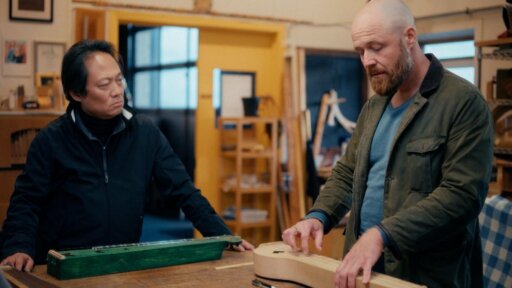
So this is a langspil?
-Yes, this is it.
Langspil is the traditional instrument of Iceland.
This is what I like about the langspil, is because not so much is known about how exactly it looked, so you're quite free to interpret it and be creative.
-Exactly.
It's very much in tune with folk traditions.
But still, it's a part of a big family of drone zithers.
I would say the American equivalent is the dulcimer -- Appalachian dulcimer.
And therefore, the most famous langspil player in the world is Dolly Parton.
-[ Laughs ] -She plays the dulcimer very well, yeah.
-So, you have the bows out.
How do you play one of these?
-Yes.
In Iceland, we play it with bow traditionally.
So you might just, like, play the drone strings first, and then you pick up the melody string.
[ Langspil plays ] ♪♪ That.
But you can also pluck it, which is quite nice.
♪♪ And, also, if you would drone with me, you have these... -Okay.
♪♪ Exactly.
Yeah, very nice.
And, then, you can also hammer it, like this.
♪♪ But traditionally, they would be used for accompaniment.
-Accompaniment of?
-Singing.
-Nice.
-Yeah.
-So can you play something on the langspil so I can hear a piece?
-Of course, yeah.
Would you mind playing with me a bit?
-Sure.
A drone?
♪♪ ♪♪ ♪♪ ♪♪ -♪ Undir bláum sólar sali ♪ ♪ Saudlauks upp í lygnum dali ♪ ♪ Fólkid hafdi af hanagali ♪ ♪ Hvorsdags skemmtun baenum á ♪ ♪ Fagurt galadi fuglinn sá ♪ ♪ Og af fleiri fugla hjali ♪ ♪ Frygd um sumarstundir ♪ ♪ Listamadurinn lengi par vid undi ♪ ♪♪ ♪♪ ♪ Hunangsblóm úr ollum attum ♪ ♪ Ylmi saetum lífga máttu ♪ ♪ Songpípan í grasagáttum ♪ ♪ Gjordi tíd á enda kljá ♪ ♪ Fagurt galadi fuglinn sá ♪ ♪ Skjótt var lidid langt af háttum ♪ ♪ Lagst var allt í blundi ♪ ♪ Listamadurinn lengi par vid undi ♪ ♪♪ ♪♪ -To learn more about Iceland's musical history, I went to an old Lutheran Church in the center of Reykjavk to meet musicologist, author, and historian Arni Heimir Ingólfsson.
-I guess you could say that for most of Icelandic music history, Iceland was kind of stuck in the Middle Ages.
Iceland was settled by Norwegians in the 9th Century, but the earliest music that we have here is church music, because Iceland was Christianized around the year 1000.
And so for a very long time, the only music that Icelanders were singing and performing was folk music and music for the church.
And there are a few different types of Icelandic folk songs, but one that's unusual, I would say, probably for people outside Iceland is a type of singing called tvísongur, which really just means singing in two parts.
-Okay.
Well, that's pretty common.
That's pretty common.
The interesting thing is that the intervals between the two lines that are being sung are always parallel fifths.
-Like all the time?
-All the time.
-Really?
-And parallel fifths, as we know, are forbidden in classical music.
I mean, that's one of the first rules that you learn when you take a beginning theory class is no parallel fifths.
-Sure.
-And it sounds to us really quite strange.
-Yeah.
You know... [ Violin plays ] ♪♪ -It sounds quite archaic and a bit sort of grim.
-Yeah.
-But these parallel fifths are part of what makes Icelandic music really unusual.
[ Choir singing in Icelandic ] -At Hallgrimskirkja, Iceland's great cathedral, their choir was ready to give me an example.
♪ Krossins ord pitt út breidi ♪ ♪ Um landid hér ♪ ♪ Til heidurs pér ♪ ♪ Helst mun pad blessun valda ♪ ♪ Medan pín nád laetur vort lád ♪ -These harmonies may be unique to Icelandic music, but they sound pretty great to me.
♪♪ -So, Icelanders sang like this for a very long time.
We have a whole repertory of songs.
-So when did everything change?
Everything started to change in the late 19th Century and the early 20th Century, partly because this is a time when Iceland is starting its push towards independence.
Iceland was part of the Danish kingdom.
And there's a sense that if we want to become a nation among nations, then we need a national theater, a national gallery, a symphony orchestra, a music school.
The infrastructure had to be there.
-That's a very sort of enlightened leadership.
-Yes, yes.
Exactly.
-So, out of this movement, were there some good composers that came out of it?
-Absolutely.
One of the first Icelandic composers to really have a strong impact was Jón Leifs.
-Leifs.
-Leifs.
He was very occupied with this idea of what does Iceland sound like and creating a broader style that was based on the elements.
You know, you have this vast wilderness, and you have these expanses of, you know, very quiet, calm, but, then, also, this unpredictable nature that can often be quite violent, as well, so this idea of really trying to re-create Iceland musically.
[ Cello plays ] ♪♪ -I wanted to ask one of Iceland's best contemporary composers, Anna Thorvaldsdottir, how she interprets Iceland in her music.
-We're going into a bit darker space.
There's a nice, big space we're gonna rehearse in.
-Okay.
♪♪ ♪♪ My friend, the cellist Johannes Moser, was here to perform her new concerto.
♪♪ -Yeah.
Wonderful.
I love how you start on the "C" string.
It really kind of manifests this dark opening.
-So, actually, Anna, I had a question about... You ask for some special effects, and you ask for non-pitched notes.
So they're not like... [ Cello plays ] But they're more, like, scratchy sounds.
For example, we have something like... Or we have some pitch-less sounds like... ♪♪ So I'm trying to see what you had in mind, actually.
-I do think about them like any other melody.
For me, it is about the musical material.
It's like you get a shadow of a pitch.
So it's something very simple, like... [ Bow scraping ] It can be really musical without being really -- You can almost not even hear the pitches.
-Mm-hmm.
-You know, Anna, your music has so much texture in it and so much space.
And I'm wondering if the geography of Iceland somehow has informed your creation.
-It's not unlikely, because, I mean, I grew up here in Iceland.
My roots are here.
And even though I've lived abroad for many, many years, it lives with me in my music -- the sense of space and the sense of the wind is almost always blowing and you have all these sounds connected to that.
It's not that I'm trying to take a natural element and put it into music.
It's more that it becomes an inspiration and manifests as this combination of textures and lyricism and harmonies.
Yeah.
[ Choir singing in Icelandic ] -Their rehearsal was happening in Harpa, the magnificent concert hall that's also an interpretation of Iceland.
I talked to C.E.O.
Svanhildur Konrádsdóttir.
What motivated the design of this building?
I mean, it's so unique.
-Icelandic nature.
And the architects -- they actually did travel to the highlands of Iceland to get the inspiration.
So it's very direct.
You can see it in the façade of the building, where you have the formation of the basalt columns you find in Icelandic nature.
You see it in the black color of the walls and the floor, which are the black sands.
You see it in the cascading staircases, you know, that are the waterfalls of Iceland.
And you see it of course in Eldborg, which is our main concert hall, and that is the volcanic, fiery heart of Harpa.
[ Choir singing in Icelandic ] ♪♪ What makes Iceland absolutely unique is the light.
And this building could only have been made in Iceland.
-Wow.
♪♪ -Icelandic nature is full of contrasts.
I mean, we have these magnificent mountains.
You have these empty spaces up in the highlands -- you know, the black lava, the fire in the volcanoes, geothermal energy.
So it's full of energy and full of life.
So it really seeps into the expression of artists and I guess all of us.
-Mm.
-In the basement of Harpa is the percussion room, where Eggert Pals and Steef van Oosterhout showed me some instruments made for that Iceland sound.
Jón Leifs -- I know him.
-Jón Leifs.
You've heard of him?
-Of course.
He's famous here.
-Yes, he is, actually.
-And what does Hekla mean?
-Hekla is a volcano -- probably one of our most renowned volcanoes.
-So this is a big piece?
-It is a very big piece.
It was nominated at some point to be the loudest pieces ever written.
-Oh, really?
-It requires a big orchestra -- 18 or 19 percussionists.
-God.
That's like more percussionists than first violinists.
-With everything ranging from snare drums to cannons and chains.
-Chains, too?
-Chains, yes.
-Are these the chains?
-These are actually the chains.
-You just pull it to play it?
-Steef, would you do me the honor?
-1, 2, 3, 4.
[ Chains rattling ] -This is probably not for the softer parts of it.
-Right.
[ Laughs ] Does this show up in Hekla, as well?
-This is there, as well.
-This is not very subtle.
-No, really.
No, no.
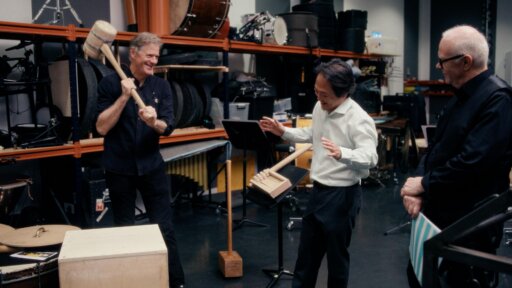
He writes for a big hammer, played on wood, any wood.
-Okay, okay.
-I can give you a demonstration.
[ Hammer bangs ] -Oh, God!
[ Both laughing ] -This is mezzo piano.
-Whoa!
And what is this made out of?
-This is made from a piece of driftwood, which yeah, there's a lot of driftwood in Iceland.
-It's beautiful.
It's an instrument.
It's beautiful.
-The instrument should look nice.
-Yeah, it does.
-Hey, what are these cymbal-looking things here?
-These are the scudi.
They are shields -- musical shields.
-Can I try this one?
-Absolutely.
-Alright.
Let's see.
-Go ahead.
-Okay.
So... [ Shields clanging ] I probably don't have your technique.
-You're hired.
-You're hired.
-Wow.
-Excellent.
-So, does this show up in Leif's piece, as well?
-Yes.
-Several.
-Really?
Several?
-We premiered these pieces.
-Can I hear some Leifs, just with some of these percussion instruments, to sort of understand the sound?
-Yeah.
We'll call the team in.
[ Drums beating ] ♪♪ ♪♪ ♪♪ ♪♪ ♪♪ ♪♪ -Speaking of volcanoes, it was time for me to go down into this one.
♪♪ ♪♪ Okay.
-You're gonna descend about 400 feet, all the way down to the bottom.
If you look down on that side there, kind of see all the way down to the bottom.
-So, this is the cone of a volcano that went off 4,000 years ago?
-Yeah.
About 4,500 years ago, you would be swimming in lava right now.
-Wow.
-But you're gonna go through the same way that the lava came out.
Everything you see around you was made in the eruption itself.
It's the only way you have land in Iceland, is erupting volcanoes.
And so, I mean, Iceland forever has lived with the reality of eruptions.
Iceland erupts on average every four to five years.
-It's getting colder.
-It is.
If it feels a whole lot warmer very quickly, let us know.
[ Laughter ] -♪ Ad minni sálu amar ♪ -Inside a volcano seemed like a fitting place for another traditional Icelandic song.
-♪ Uti er gledi og gaman ♪ ♪ Gefist ei bótin snart ♪ ♪ Sjálf ber hún med sér hungrid hart ♪ ♪ Skortir sitt brúdarskart ♪ ♪ Og skin Guds nádar bjart ♪ ♪ Hvert skal ég haelis leita ♪ ♪ Henni svo verdi frítt ♪ ♪ Pó heimur vilji veita ♪ ♪ Vegsemd og skjólid sitt ♪ ♪ Ekki á slíkt vid meinid mitt ♪ ♪ Vad er fals fagur litt ♪ ♪ Fellur í daudans pytt ♪ -A more recent eruption happened on Iceland's Westman Islands.
-♪ Sem edla vex úr rót ♪ -♪ Vex úr rót ♪ -♪ Fagurt med fjórslags greinum ♪ ♪ Og fullt af heilsubót ♪ -♪ Heilsubót ♪ ♪ Breidir ávoxt og blodin mót ♪ ♪ Af pví med andleg hót ♪ -The entire town had to be evacuated to the mainland.
♪♪ At their Eldheimar Volcano Museum, I saw firsthand how Iceland's volcanoes shape their lives with Director Kristín Jóhannsdóttir.
So, this house was excavated, and, then, they built the museum around it.
-Yeah, that's right.
This house is one of 350 houses that were destroyed in the volcano eruption in 1973.
It was not only lava, also, millions, billions of tons of ash.
-Ash.
-This volcano ash, there were around 60 meters on the top of this.
-You know, it's really -- I mean, It's incredible.
You see ash and lava.
But it's also kind of personal and poignant to see, like, a spoon or a light bulb or a piece of jewelry or a piece of clothing.
-You have to keep in mind, we didn't have any warning, and it was just, "You have to leave now."
So they just took the very most important things, and, then, they left.
Many of the people did lose everything that night.
But we had a lot of luck.
We could say that.
Because there was a lot of damage, but nobody died.
-Were you actually here on the island that night?
-Yes.
-What happened?
-My father did wake me up, and my brothers, we were all sleeping, and he was kind of upset.
I did hear him saying many times, "Oh, my God.
Oh, my God."
-Mm.
-We did look out of our windows, and we saw it was like a wall of fire.
Like, the east part of the island was burning.
We were told that we should go to the harbor and leave.
So our father, he did bring me and my brothers to one of the fishing boats, and he did stay.
He stayed here all the time.
And he was joining the rescue teams.
And that was not undangerous, because nobody knows what the volcano is gonna do.
-So, this is a pretty common thing in Iceland.
A volcanic eruption, something will just completely change somebody's life, change a family's life, change a town's life.
-The guests ask, "How can you live here?
Aren't you afraid of the next volcano?"
And, then, I say, "No, I'm not."
We can deal with the nature.
We are quite sure about that.
The nature can change our life, of course, but we have to live with that in Iceland.
[ Choir singing in Icelandic ] ♪♪ ♪♪ -Lava from the volcano flowing into the sea added more than four square miles to the island -- something that Westman Chef Gísli Matt uses to his advantage.
-So, here, we're walking on new land.
There was nothing, just the sea here, like, around 50 years ago.
-Really?
-Yeah.
-So, Gísli, what are we looking for here?
-So, we're looking for oyster leaves.
-Okay.
-And the amazing thing about it, it has a slight flavor of oysters.
-Really?
-Just raw oysters.
-Really?
-Definitely not the texture of an oyster, but the taste is there.
So, here it is.
-Okay.
-I was once working at a restaurant called Eleven Madison Park, which is in New York.
-Oh, sure.
It's very famous.
-Very famous.
I was doing an internship.
And I was asked to cook a dish, and I only had 30 minutes to do so.
And they told me I could use everything in the kitchen except for foie gras, truffles, and oyster leaves.
And back then, I had never heard of oyster leaves.
They were importing them fresh from Alaska and paying $1 per leaf.
And there I was standing, just like, "I've seen this before."
[ Laughs ] -You grew up with this?
-Yes.
But, like, nobody kind of knew that it's quite a special herb.
So, if you want to taste it, it has like -- like a brininess.
-Mmm.
-But it grows wild all over, here in Iceland and all over the beaches.
-And for you, it's free.
-It's free, yeah.
[ Chuckles ] Yeah.
Like, all these herbs can be used -- sea sandwort, mountain sorrel, some lyme grass up there.
It's actually quite high tide now.
-Uh-huh.
-But there is still a lot of seaweed that we can find.
-Okay.
-We use around 12 types of seaweed at the restaurant.
This is the most commonly used in Iceland.
It's called dulse.
-Okay.
-When it's dried, it has almost, like, a licorice-y, like, quite dark flavors.
-Okay.
-But, then, when you're foraging all the time, you get curious about all the different varieties.
This is called pepper dulse.
-Okay.
-Then this is one of my favorites here.
It's called sea lettuce.
-Sea lettuce.
Nice.
-It's so fragile, you can just eat it in a salad, just lightly dressed.
We use this quite a lot.
This is sugar kelp.
It's amazing to use for broths.
So, I think we should just take that back to the restaurant and cook some food.
-Awesome.
-Amazing.
-Okay.
[ Both laugh ] 15 years ago, Gísli and his family opened this restaurant, drawing foodies and food writers from around the world to his little corner of Iceland.
-Alright.
Welcome.
-Okay.
-So, this is a sugar kelp seaweed broth with a cracker that's made from nori seaweed.
-I recognize that.
-Yeah, the oyster leaf.
-Nice.
-And some seaweed capers.
-And then here is cod skin that we've salted, dried, and puffed.
-Wow.
-Hope you enjoy.
-Very, very impressive.
Mmm.
[ Laughs ] Oh, my God.
Mmm.
Mmm!
That is laughably good.
Whoa!
Lots of stuff.
-This is a sea urchin.
And here you have a cured halibut, which is cured with the arctic thyme.
And, then, here, you have our cod wing.
We love filling the table with food.
-Wow.
That is outrageous.
Oh!
Mmm.
Wow!
-Has everything been alright so far?
That is a world-beating uni.
That's the world's best uni.
-Amazing.
Amazing.
-You know, you can only have this meal not just in Iceland, but only on this island.
-That is hopefully what makes it special, is that you can only get it here.
[ Classical music plays ] -It seems all of Iceland's arts are profoundly shaped by this unique environment.
-Back at Harpa, conductor Eva Ollikainen ran the Iceland Symphony Orchestra through Anna's cello concerto.
♪♪ ♪♪ -Second cello more!
♪♪ ♪♪ ♪♪ Okay.
Yeah.
So, the ninth duplet is over two beats, isn't it?
Yeah.
So, first clarinet, bass clarinet, bassoons.
I think some of you tried to play a little bit shorter, those notes, but really... ♪ Yom-bom-bim-bom-bom ♪ it is three duplets.
What else, Johannes?
-Eva, it's a bit too fast for me.
I needed a little bit more space for... [ Cello plays ] ...to make it speak.
-Yeah, sure.
-Just to hear the notes a little bit more.
-Eva?
So, I was wondering with the second part, because it's so completely different from the first part, that it would be nice to have the atmosphere be kind of laid-back a little bit.
So he draws you in, like, with the glissandi in the strings.
He's drawing you in there with that.
-Okay.
-And, like -- -It feels a bit driven still, right?
-Yeah.
So felt a little bit driven.
And this is only for kind of inspiration.
-Yeah.
It's a little bit more meditative somehow, the second part.
-Yeah, yeah.
Absolutely, absolutely.
-Yeah, yeah.
Yeah.
We can do that.
-Yeah.
-Okay.
So letter "J."
[ Classical music plays ] ♪♪ ♪♪ ♪♪ ♪♪ ♪♪ ♪♪ ♪♪ -Every Icelandic musician in this orchestra is a product of their superb school music program.
To learn more, Jófrídur took me back to her grade school to meet her old friend, Birkir Hafsteinsson.
And so do you teach music here, like music class here?
What do you teach?
-I teach clarinet here.
So, they have private lessons two times a week for each student.
-So, for us, we're lucky if we have a music budget at all.
I mean, you teach private lessons?
-Mm-hmm.
-I mean, it's pretty integrated into the school system, and it's across the country.
It's quite common that you to have access to band and, also, private lessons.
-Boy, lucky Icelanders, huh?
-No, I know.
-That's fantastic.
-We don't realize how lucky we are.
I mean, I started when I was 7, with a private teacher.
-Mm-hmm.
I was 8.
-Yeah.
-In that room over there.
-This room?
Nice, nice.
-Yeah.
-It's why we have so much music here.
It's because it's not an elitist thing.
It's not a class thing.
It's a community thing.
And this is what we do to socialize.
-Yeah.
We play in bands.
We play in our classical environment or in jazz or choirs.
There's a lot of culture for singing in choirs.
And it is to meet and to socialize and to play together.
-So, I have 55 students that meet me two times a week, which is awesome.
And I'm also conducting clarinet choir.
-Clarinet choir.
I've never heard of that.
-And this is how we met, you know, 10, 12 years ago, when we were together in music school.
I was studying the classical clarinet.
And now Birkir is the conductor of the same choir.
-That's really neat.
And do you ever sing with the clarinet choir?
-So, we have this one particular song that we did, yeah, together, where I arranged one of my songs for clarinet choir.
♪♪ ♪ Once an orchid sat ♪ ♪ In a silver light and solemnly waited ♪ ♪ Slightly breathing ♪ ♪ Touched its glistening tear ♪ ♪ Only one dream away from a perfect birth ♪ ♪ One promise away from birth ♪ ♪ One secret away from ♪ ♪ One promise away from ♪ ♪ One dream a... ♪ ♪ One kiss away from life ♪ ♪ From a life ♪ ♪ From another life ♪ ♪ From another life ♪ ♪ You know, you know, you... ♪ ♪♪ ♪♪ ♪♪ ♪♪ ♪♪ ♪♪ -Finally, to see how Iceland's traditional culture and folklore shapes its music, I went for a drive with composer and conductor Danel Bjarnason.
[ Birds chirping ] -So, here we are next to a famous rock that is named after the elf that lives inside of it.
His name is Staupasteinn.
-This is his home?
-This is his home.
And for those who can see him -- and there are quite a lot of people in Iceland who can still see the elves and the hidden people -- they say he's quite friendly.
-Somebody left an apple for him.
-I'm sure he will be very happy.
Let's walk up here, and we'll get a great view of the fjord.
-Okay.
Wow.
It's [chuckles] pretty cool.
-So, this is Hvalfjordur, which means "whale fjord."
The name is thought to have arrived from an old legend about a man who fell in love with an elvish woman, and they had a child together.
But he did not want to recognize that he had this child, and she became very angry with him and turned him into a whale with a red head -- and it was called the Red Head -- and banished him to the oceans, where he would terrorize and plague the fishermen for many, many years, until eventually, an old priest who had lost two of his sons to the Red Head whale through some sorcery was able to drag him onto land, where he actually exploded.
So that was the end of the Red Head.
-[ Laughs ] -And that's where the name probably comes from.
-Icelanders -- they have an imagination here.
-Yeah.
We have a lot of fun stories like that.
-Folk traditions have influenced classical composers here, as they do elsewhere.
I met Arni again at the Reykjavik church.
-Jón Leifs actually collected Icelandic folk songs.
So he went around the country with a little cylinder recording device.
And he recorded farmers and fishermen and people all over the country, because he was really interested in what was the original sound that he could use for his music.
And because we were talking about the parallel fifth singing earlier, one of the other types of traditional Icelandic folk singing is also quite unusual.
It's called rímur.
And the unusual thing about that is the rhythmic structure, because they're reflecting the metric pattern and the syllable count of the poetry.
-I see.
-So every syllable gets one note, basically.
It's a bit unpredictable, I guess, if you're hearing it for the first time.
But once you understand the way it comes from the poetry, it all makes sense, because it's just reflecting the way the poetry is structured.
-Can I hear it?
-Yes.
Absolutely.
So, you have... [ Piano plays ] ♪♪ -I'm already lost.
-Okay, okay.
[ Laughs ] -So, let's see.
What did he do here?
Oh, so that's how he notated it -- 4/4, 2/4, 3/4.
-Exactly.
-And he can just kind of choose.
-Exactly.
-Can you play that again?
-Yeah, yeah.
[ Piano plays, rhythmic clapping ] ♪♪ -That's cool.
♪♪ ♪♪ ♪♪ ♪♪ The Icelandic climate shaped their traditional houses, which shaped their culture.
Many lived in compounds like this well into the 20th Century.
I went there with Eyvi, Jóf, and her sister, Asthildur.
-Turf houses would always be built according to the winds and the sun.
So, the main side, of course, is on the south side.
And you see the black house there.
This is the kitchen -- the same type of kitchen people have been using since medieval times.
And the walls are very, very thick, made of turf and rocks.
-What, like this?
-Oh, no.
Probably like this, at least, you know?
-So that's a lot of insulation.
-Yes.
-And that's why people were able to, you know, survive the winters.
-You know, they might look a bit rustic, but they're very functional, and there's a reason why they have lasted for so long.
-Can we see the inside of one of these?
-Of course.
Yeah, come on.
Come along.
-It's really small in here.
-[ Chuckles ] -I mean, it looks bigger from the outside, but it's small.
-So, this is the center room.
And this is, also, the center place of Icelandic culture through centuries.
-How many people lived in here?
-How many beds are here?
-Five.
-Five.
So calculate that with two, you will have the number of people.
-So everybody shared?
-Yeah.
The only source of heating were the bodies themselves.
-Oh, really?
-And if a bed would be empty, they would bring in an animal, a sheep or a calf, to put in the bed so they wouldn't lose the heating.
[ Laughter ] -So, this is before electricity, before the Internet.
What would people do in a house like this?
-Yeah, there's storytelling, there's chanting, rímur.
And there would be traveling musician performers who would go from farm to farm and entertain the people.
-Literacy was very common.
This was the sole light in the badstofa.
And the ruler of light was the head of the household and would decide what was being read.
And it also gives us this important notion of the darkness in this room and where folklore was created.
-And it was dark a lot.
-Yeah.
We live, like, in darkness for a big part of the year in Iceland.
-It certainly influences your behavior... -Yeah.
-...and what you spend your time doing.
-Do you write more songs during the winter months?
-Writing songs is a perfect thing to do when you're inside in a small room.
And I think kind of maybe even architecture, spending time indoors in small rooms, can influence the sound.
-Are the songs more intimate or your voice more intimate?
-In Iceland, we work a lot on headphones.
-We have a great connection to details.
A lot of people say Icelandic music is textural.
But maybe it's also just because in Iceland, it is silent.
It is very quiet.
[ Intro to "Somewhere" plays ] ♪♪ ♪ We should have left our hearts in the forest ♪ ♪ Where they first met ♪ ♪ We take them back, but now they are broken ♪ ♪ And start to slowly forget ♪ ♪ La da da, da da da da ♪ ♪ Da da, da da, da da da da, da da da ♪ ♪ La da da, da da da da ♪ ♪ Da da, da da, da da da da ♪ ♪ And if I don't see you now I'll see you another year ♪ ♪ We will be reunited someday, somewhere ♪ ♪ And our love, it will fade, but we know that it was there ♪ ♪ We can make it reappear someday, somewhere ♪ ♪ La da da, da da da da ♪ ♪ Da da, da da, da da da da, da da da ♪ ♪ La da da, da da da da ♪ ♪ Da da, da da, da da da da ♪ ♪ Cherish and embrace it ♪ ♪ Appreciate the time we got ♪ ♪ I ask you to forget me not ♪ ♪ Someday, somewhere ♪ ♪ And our love, it will fade, but we know that it was there ♪ ♪ We can make it reappear someday, somewhere ♪ -Daniel wanted to show me one more Icelandic tradition.
There are hot spring baths on the edge of this fjord.
Everybody talks about how beautiful Iceland is, but when I arrived, I was really, truly shocked.
It's so incredible here.
-It is incredibly beautiful.
And whenever I come back home when I'm traveling, I feel really grateful to live here.
It's a very special place.
I think Icelanders really do appreciate the beauty of this place, but I think they're also quite aware that under the surface of beauty, there is also a lot of danger.
This wasn't always an easy place to live in for the generations that came before.
And it's awe-inspiring in many ways to live here, but it's also terrible, and you need to treat it with respect.
-Beautiful.
[ Suspenseful music plays ] ♪♪ This has got to be one of the most picturesque hot springs in the world.
This is one of a kind.
-Yeah.
This is a really, really beautiful spot, this hot spring here, called Hvammsvík.
-But this is also the result of volcanic activity, right?
-I mean, this place is full of contrasts.
You know, we have the extreme cold, and, then, we have this heat rising from the Earth.
You know, we have almost completely bright summers, and then it gets very dark in the winter.
And it's always swinging between these two extremes.
-They live together in one small country.
-That's true.
♪♪ -So why is Iceland so musical?
This beautiful, terrible landscape certainly shapes their art.
And you can hear it in Anna's cello concerto.
♪♪ ♪♪ ♪♪ ♪♪ ♪♪ ♪♪ ♪♪ ♪♪ ♪♪ ♪♪ But there's more to the Icelandic sound.
♪♪ This soaring, choral hymn, so different, is also by Anna.
-♪ Síst skarta songlist má ♪ -That says a lot about Icelandic musicians.
-♪ ...elskan hjá ♪ ♪ Syngjum... ♪ -In a small population, they must be versatile, easily crossing genres.
They're classically trained, yet shaped by a thousand years of distinct culture.
In dark winters, they have time and silence to create.
In bright summers, they explode with song.
-♪ ...pess gá ♪ -This magnificent choir, by the way, are all amateurs -- Icelanders who come together to sing together.
They are doers, as they say.
And what they do is music.
I'm Scott Yoo, and I hope you can now hear this.
-♪ Oss tak pá Gud ad pér ♪ ♪ I pá dyrd sem aldrei pver ♪ ♪ I pá dyrd sem aldrei pver ♪ -This program is available with PBS Passport and on Amazon Prime Video.
To find out more about this and other "Great Performance" programs, visit pbs.org/greatperformances.
And follow us on Facebook and Instagram.
-♪ ...sker ♪